Showing posts with label History. Show all posts

Friday, September 25, 2015

"The 100 Year Old Man" - A Felix Herngren Film (2015)

This is a very good film. I’m not quite sure how to review it without taking anything away from the steady stream of surprises which this film holds in store for the viewer. 

I have to confess something here; I am probably the only person on the planet who disliked the film “Forrest Gump.” I have never made it through more than 15 minutes of it. And yet this film is somewhat similar. And that’s all I will tell you. I will give you this much though; here are the notes, right from the back of this exceptionally creative film.

“After a long and explosive life in munitions, involving a multitude of seminal moments from the 20th Century, including the Spanish Revolution, the atomic bomb, and the Cold War, Allean Karlsson finds himself  - on his 100th birthday – stuck in a tranquil Swedish nursing home. Determined to escape the monotony he hops out a window and kicks off a hilarious and unexpected comic-adventure by way of a stolen briefcase, a hardcore biker gang, and an escaped circus elephant named Sonya.”

It’s funny that as I read the liner notes today I think I understand more fully the difference between “Forrest Gump” and Allan Karlsson. While Gump was a somewhat of a bystander caught up in the circumstances around him, Karlsson is more pro-active, inserting himself in the situations which present themselves. And for me, that makes all the difference.

Sunday, August 30, 2015

"Beale Street Dynasty" by Preston Lauterbach (2015)

This book is yet another stone in the path of musical history in the United States. New Orleans may have been the point of entry for much of the music which came from Africa and the Caribbean, but Memphis is one of the towns in which it was reshaped into its own unique form. The Memphis Blues is different than let’s say Chicago Blues, or Delta Blues. They may all have begun at the same place, but the journey up the Mississippi left its own mark on the music with each town it passed through.

Just as in his earlier book “The Chitlin’ Circuit and the Road to Rock and Roll”; which I reviewed here in 2011, Mr. Lauterbach brings to life the tumult of post-Civil War Memphis and the interracial society which sprang up there in the days before Jim Crow.  Memphis was a virtual Mecca of the way things should be regarding race relations. There were African-American lawyers, barbers, accountants, newspapers, hotels and everything else you would expect in any community in the 1870’s.

Politically the town was also seemingly color blind, and with the guidance of Robert Church, a mulatto steam boat Captain, the town continued to thrive. As a matter of fact, in many ways it was the exact opposite of other Southern towns. In many ways the African-Americans were prospering, and even leading, in the areas of finance and entertainment. Interracial marriage was a common thing and African-Americans enjoyed most of the privileges of their white neighbors.

With a deft hand and a keen style of writing, Mr. Lauterbach charts the course of change in Memphis from the riots after the Civil War to the time when it was the gem of the South around the turn of the Century. At that time it was said that any white man who spent even one night on Beale Street would never want to be white again.”

But, with the advent of the First World War came the first harbingers of change. Just as in New Orleans, the authorities clamped down on the music and the prostitution, and strengthened miscegenation laws to keep the races apart.

The story of Memphis, Robert Church and W.C. Handy; along with scores of other musicians; is widely known, but Mr. Lauterbach has taken the politics of the time and melded it with the cultural and criminal elements which made Memphis the place it was then, as well as today, and turned it into an all-encompassing history of Beale Street and the blues in Memphis . 

For a review of Mr. Lauterbach’s “The Chitlin’ Circuit” hit this link;


Monday, August 3, 2015

"The Constitution" by Michael Stokes Paulsen and Luke Paulsen (2015)

Finally; a book about the Constitution which doesn’t have an agenda! I had almost given up hope. The only complaint I could possibly have with this highly informative and unbiased look at our Nation’s most sacred document is the same as with most books about the Constitution; they don’t include a copy for reference. Since the authors refer to Articles and Amendments on just about every page, it would have been convenient. Fortunately I have several copies strategically located throughout the house and 2 more in the car. Beyond that oversight, this book is a refreshing look at the Constitution; absent of any political bent.

The authors begin at the beginning; a very good place to start; and then take us chronologically through the history of the document itself and it’s remarkable life through over 2 centuries of tumult, chaos and division. The resiliency which the Founding Fathers built into this document is clearly on view; and easily understood in the treatment afforded it by this book.

Different readers will favor different parts of this work; but all readers will take away new insights and understandings from reading it. So nuanced is the Constitution that; in many ways just as with the Talmud;  you can read something several times over, only to have the apparent meaning change with each successive reading. Add in over 2 centuries of social change and you have quite a range of interpretations!

From the beginnings of Marbury v Madison; all the way through the latest controversial Supreme Court rulings; this book, and these authors, have presented us with a gift for these tumultuous times. To avail yourself of the wonderful fruits this gift offers, you need only open the first page.

Monday, June 15, 2015

"Russian Roulette" by Giles Milton (2015)

When you watch films such as “The Four Feathers”, or “The Bengal Lancers” and “Gunga Din” you may be tempted to dismiss them as mere dramatizations of history, but you would be shortsighted to do so. Those films actually portray the British struggle to maintain control over India during the last days of the Raj in a fairly accurate way.

In his latest book, “Russian Roulette”, author Giles Milton takes us back to the days of the First World War and the Russian Revolution to illustrate the way in which Lenin’s Bolsheviks were prevented from exporting the Revolution to India by way of Afghanistan, Turkestan, and also how the British developed the Secret Intelligence Service; commonly referred to as MI6.

Reading this book is almost like watching one of those old movies I mentioned earlier; only better. When the Russian people finally had enough of the war; which was decimating the working class; they revolted. The Revolution is always considered to have occurred in November of 1917 when the Bolsheviks finally got to kill Tsar Nicholas and his family, but the truth is that it was brewing for some time.

Aside from the obvious problem of having Russia leave the war against Germany was the security of the large stores of ammunition stored within Russian borders. The concern was twofold; should the Germans acquire it then the tide of the war in the area would be turned. On the other hand, should the Bolsheviks get ahold of it then we risked losing Russia to internal strife. To deal with the political problems this engendered the British created an espionage network which spawned what some have termed “the Great Game”; a game which continues today in the same areas as it began, between the same powers that began it.

When the war ended the British efforts to stop the spread of Bolshevism didn’t end; if only for the fact that Lenin was actively pursuing a foothold in India to topple the British Raj. To that end, Amir Amannullah; the ruler of Afghanistan at the time; issued a jihad directing a Holy War against British India in 1919. 

But as determined as the Russians might have been to expand their reach into India, the British were equally determined to oppose that expansion. To that end they chose to use some 50,000 shells of a toxic gas known as “the M-Device.” This was a nechloroarsine, which caused instant death in some; and violent illness in others. Churchill declared it to be more humane than explosives. Of those 55,00 shells, 47,282 remained unused and were dumped in about 240 feet of water in the White Sea, where they remain until this very day. Ninety years later Britain would be chief among those nations condemning Saddam Hussein for gassing the Kurds in Northern Iraq.

The book is filled with the characters you would expect to meet in films like “The Man Who Would Be King”. Some of these men were professional adventurers; some were men with political bents; others were just “doing their bit”; but all of their stories reflect, if not surpass, the antics of all the stars in those movies I mentioned earlier. Several have left manuscripts; published and unpublished; which the author has used to create a wonderfully accurate picture of a time and place which has not changed much since the time these events occur.

The names of men such as Mansfield Cumming; Arthur Ransome; Robert Bruce Lockhart; Sidney Reilly and George Hill may be lost in the greater annals of history, the rocky plains and mountainous areas of Afghanistan are still the same. And the “Great Game” still continues on its useful; and sometimes incomprehensible; course. This book will aid you in navigating that history.

Monday, May 25, 2015

"Empire of Sin" by Gary Krist (2014)

This book is an enigma. It begins as an examination of the famous New Orleans Ax Man Murders of the early 20th Century and just when you are settling in nicely with that gruesome crime, the book becomes a history of jazz and after that morphs into a collective biography of some of the greatest jazz musicians who ever lived.

So, just what is this book? Well, I’ll tell you; honestly this is one of the most invigorating and engaging books on serial killers and jazz musicians which I have ever read. The big difference in the two subjects is that, of course, while the Jazzmen chronicled here may have slayed their audiences night after night with the new sound called “jazz”, the Ax Man murderer was slaying his audiences permanently in private performances all over New Orleans for several years. His crimes are still listed as one of the most puzzling of all serial killers, including the infamous Jack the Ripper.

Mr. Krist is an accomplished author, and it was his name which drew me to the book, the complicated title notwithstanding. Just how he wound up juxtaposing the history of what was happening in New Orleans at the time of the murders with the history of jazz is somewhat of a mystery to me, but the justification for doing so becomes apparent as you read the book.

New Orleans was a wide open Southern city; if you could call it a truly Southern city at all. There was no real segregation and racial intermarriage was quite common before the early part of the 20th Century. Gambling and prostitution were openly practiced, if not celebrated. And the Port of New Orleans brought together sailors from all over the Caribbean, Europe and Africa; not to mention an influx of Asians and South Americans. And in the days of Reconstruction all of these different people lived together in relative harmony.

At the close of the 19th Century there was an influx of European immigrants; notably Irish, Italian, German and Jewish. Each group had their own customs; and music. The first race riots in the city were not; as one would expect; between blacks and whites. Rather they were between the whites and the Italians. The Italians had become known as a “mafia” like organization. They were involved in kidnappings and extortion. They also strong armed their own neighborhood grocery stores, and in some cases murdered the owners. But when a group of these men kidnapped a young child and killed him, the city exploded in the violence of revenge.

Against the backdrop of those events in 1890 the author traces the history of crime in New Orleans through to the end of the 1920 election and the advent of Prohibition. As I said earlier, had he only concentrated on this aspect of New Orleans at the time this would have been a great book. However, by choosing to combine and compare the history of crime in New Orleans with the creation of jazz, he has created a fantastic and lively portrait of one of America’s most beloved and eclectic cities.

The book sparkles with the names of the musical legends that gave birth to a new art form. The stories of these men; with names like Jelly Roll Morton; Sidney Bechet; Freddie Keppard; Buddy Bolden; Louis Armstrong and George Baquet; are the history of what became the modern day New Orleans of legend, but also of Storyville itself; that quarter where these men first blew the notes which would come to define an era, and a genre.

Here is a link to the Library of Congress recording of Alabama Bound by Jelly Roll Morton. This is the type of music I was listening to while reading this book. Listening to the music of the time while reading the book enriched the whole experience and made for a delightful reading of this wonderful book by Mr. Krist.


Tuesday, April 7, 2015

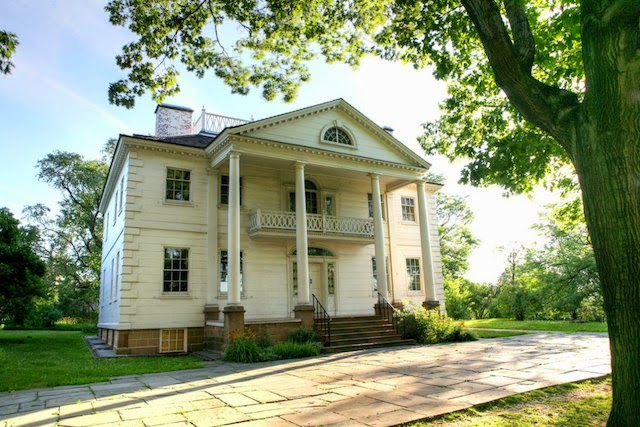
The Jumel Mansion - Manhattan

I’m not going to tell you too much about this place. I went there in 1964, just after my Mom had read about it in the newspaper. She was like that; she’d read something interesting, clip it out and the next thing I knew we were in the car and my father would be driving us to see it.

My wife is like that, too. I’m more of a drive by and see something, stop and look at it. It might seem more spontaneous, but I come up with less things than either my Mom, or Sue. So, their method is obviously a more fruitful track.

Without looking anything up I remember the story like this; Madame Jumel was the richest women in Colonial America due to some circumstances involving marriage and death. In those days that’s how it worked for women. They married as well as they could and then hoped for the early demise of the husband. Then she was free to marry the stable hand if she chose to. But, it worked both ways. George Washington married up, so to speak, when he tied the knot with Martha.

Anyway, Madame Ju
mel was involved with two men; one of whom I believe was Alexander Hamilton; but I’ll check that before I wrap this up. This is just my preliminary memory of the house and the things we were told on the tour.

At the time of our visit there had been a ghost scare at the mansion. A group of school children had gone on a field trip to see the house. When they were assembled on the front lawn a figure appeared on the upstairs balcony screaming at the children; and their very frightened teacher. No explanation was ever uncovered for the bizarre incident; other than the “ghost” screaming that the kids were making too much noise.

When we visited about a month later the docent showed us some of the window panes which had been etched upon with the signatures of either Madame Jumel, or one of her family. I don’t remember exactly. I do know this; that prior to the 1960’s the house was in disrepair and the local residents in Harlem had broken a good many of the windows.

But you could readily tell the original wavy panes from the new replacements. And these were the ones which had writing on them. The odd part was that the name and handwriting were from one particular person who had been dead too long to have done the etching on a few of the panes.

The house is on something like 160th Street in Nicholas Park. The Alexander Hamilton residence is barely a mile south of that on 141st Street, where it was relocated in the early 2000’s. It is still within the original 34 acre tract of land which Hamilton called home.

Okay, so now I will look on line for a picture of the house and a link which will tell the whole story. What you have read is merely the memory of a 10 year old kid. I’m looking forward to reading the whole story. Hope you’ll join me… here’s a great link with photos of every room.

The one of the mannequin reminded me of the fright I had when we came up the stairs to the second floor. The bedroom pictured with the mannequin was positioned in such a way that when you turned at the top of the landing you were looking right at it. As a 10 year old expecting a ghost to jump out at any minute, it did the trick and scared the hell out of me!


Wednesday, November 19, 2014

Laugh or Cry - Spinoza or The Monkees

I posted a video on Sunday of the Monkees doing “Pleasant Valley Sunday.” I posted it along with Carole King’s demo recording of the song from 1966. I got 700 hits in the first 24 hours. I had to check my counter and make sure it wasn’t counting any spam hits. It wasn’t. 68% of the hits came from Facebook, while the rest came from, well, everywhere.

Now this was a surprise. I posted it Sunday only as a place holder, and because it had the word Sunday in it. I never expected more than 25 hits at best. I average about 200 a day; with most coming from people googling different things. At this point I have a couple of thousand posts out there, so people bump into my site all the time; just not 700 per day.

This got me thinking about what topics were the most popular. Here is a sampling of what I found just by looking at one typical week from June 2011.

Conrad Shuman – 1095 hits.

Einstein and Spinoza –  812 hits.

“Shifty’s War” – 8,842 hits.

Thomas Cole’s “The Course of Empire” – 683 hits.

“Pictures of Matchstick Men” by Staus Quo -432 hits.

Wendell  Berry’s “Manifesto” – 1,041 hits.

Remember, those totals are for over 3 years. Compare those totals to the Monkees getting 700 hits in 24 hours on a silly little blog like mine, and you will understand why I say I don’t know whether to laugh or cry.

For the benefit of those who may not have read it before, here is Wendell Berry’s powerful poem “Manifesto.” I hope it gets a couple of dozen hits.

Manifesto: The Mad Farmer Liberation Front

Love the quick profit, the annual raise,
vacation with pay. Want more
of everything ready-made. Be afraid
to know your neighbors and to die.

And you will have a window in your head.
Not even your future will be a mystery
any more. Your mind will be punched in a card
and shut away in a little drawer.

When they want you to buy something
they will call you. When they want you
to die for profit they will let you know.
So, friends, every day do something
that won't compute. Love the Lord.
Love the world. Work for nothing.
Take all that you have and be poor.
Love someone who does not deserve it.

Denounce the government and embrace
the flag. Hope to live in that free
republic for which it stands.
Give your approval to all you cannot
understand. Praise ignorance, for what man
has not encountered he has not destroyed.

Ask the questions that have no answers.
Invest in the millenium. Plant sequoias.
Say that your main crop is the forest
that you did not plant,
that you will not live to harvest.

Say that the leaves are harvested
when they have rotted into the mold.
Call that profit. Prophesy such returns.
Put your faith in the two inches of humus
that will build under the trees
every thousand years.

Listen to carrion -- put your ear
close, and hear the faint chattering
of the songs that are to come.
Expect the end of the world. Laugh.
Laughter is immeasurable. Be joyful
though you have considered all the facts.
So long as women do not go cheap
for power, please women more than men.

Ask yourself: Will this satisfy
a woman satisfied to bear a child?
Will this disturb the sleep
of a woman near to giving birth?

Go with your love to the fields.
Lie down in the shade. Rest your head
in her lap. Swear allegiance
to what is nighest your thoughts.

As soon as the generals and the politicos
can predict the motions of your mind,
lose it. Leave it as a sign
to mark the false trail, the way
you didn't go.

Be like the fox
who makes more tracks than necessary,
some in the wrong direction.
Practice resurrection.

Monday, October 27, 2014

"Heaven Cracks, Earth Shakes" by James Palmer

I have always considered myself to have a good grasp of contemporary Chinese history, and the 20th Century; particularly the years between the Boxer Rebellion through Mao's Long March; have always held a strange fascination for me. This was a period of struggle in which China sought to throw off the yoke of colonial control and establish a unified nation. This was also the time in which China became the largest Communist nation on earth.

The years after the Communist takeover in 1949 have always been a sort of confusion for most in the West, with its attendant purges and political maneuvering. This is not to say that we are that much different. We did, after all, have our own McCarthy Era to contend with. It may not have been as brutal as the purges in China, but the whole concept of that episode was not all that much different in its aims.

The ten years which spanned 1949-1959 saw many failures in China, both in industry and agriculture. The famine of 1960-1962 still stands as one of the most terrible periods in modern Chinese history, perhaps only eclipsed by the insanity of the Cultural Revolution which began in 1966, and would last almost 10 years. Both of these events would have far reaching consequences, influencing everything from the way buildings were constructed, to the way food was harvested and distributed.

In a largely misguided effort to hold onto power, Mao Tse Tung pit one faction against the other, resulting in stagnation in every part of Chinese life. All of this added to the country's lack of preparation for the year of 1976, which would see changes, both great and tragic, in China.

Just as we in the United States were finishing our Bicentennial celebration, marking 200 years of freedom, China was being tested by both nature and politics. The year began with the death of Premier Zhou Enlai, a leader more beloved than Chairman Mao. When the people attempt to publicly mourn his passing, they are beaten back by the Gang of Four. The tide of bereavement became a tsunami of anger sweltering beneath the surface. And that anger erupted in August, when a massive earthquake shook Tangshan Province, killing a half million people.

In the aftermath, the chaos and lack of preparation of the Chinese government surfaced, exposing the differences between the elite and the poor, ordinary working Chinese people. The result was a loss of confidence in the ability of the government to take care of the people, and highlighted the need for change. This would come to mark the end of the Cultural Revolution.

By the end of the year, Chairman Mao would be dead, and the infamous Gang of Four would be on trial for crimes against the state. These trials would expose a lavish life style among the leaders of what had once been a peasant’s revolution, changing China forever, and setting her on the path to becoming a world economic power.

James Palmer has done a fine job in piecing together both the political history of China from 1949 through 1976; and an even better job at depicting the earthquake and the mass chaos that followed. Drawing on survivor memoirs as well as official government documents, he has managed to write a very reader friendly account of what has become known as China's "Unlucky Year."

There is an old Chinese proverb which states, "When Heaven cracks, the Earth shakes." In this book, the author brilliantly puts across just what that means.

Friday, September 5, 2014

Move Over Barack - Elizabeth is Not the Queen!


President Obama is not the only world leader to have his legitimacy questioned in recent years. While looking up something on You Tube concerning the Coronation of Queen Elizabeth in 1953 I ran across this intriguing short documentary. Basically, it follows the family lineage of Queen Elizabeth back through the centuries in order to prove that Elizabeth is not the rightful heir to the throne of England.

Ordinarily I would not really have spent much time watching the video, but it is pretty interesting. Not in respects to the purpose stated; that Elizabeth is not the rightful heir; but for the wealth of English history contained in the film. For Americans, English history can be a bit confusing, but this neatly constructed video forms a tight little package covering the years of the English Civil War and Cromwell’s March; both seminal events in the understanding of both England as a world Empire, and the Britain of today.

You have to wonder if this film has been of any comfort to President Obama. He has been under attack about that birth certificate for so long now that this film must surely have the effect of making him feel not so alone anymore. I’m glad I’m not a politician, or a world leader in any respect. It would be so difficult to wake up one day and find out that I’m not really me!

Wednesday, July 9, 2014

Eyewitness to Lincoln's Assassination - (1956)


I'm always looking for old TV shows and unusual things to post here each day. It's not as simple as you might think. Sometimes I have 20 things ready to go at once; while at other times I am really scrambling for something interesting. It sometimes feels like "feast or famine", and at those times it boils down to "sink or swim."

At any rate, this is a cool little segment from the "I've Got a Secret" television show which aired on February 9, 1956. The guest is Samuel J.Seymour, 97 years young form Maryland. His claim to fame is that he witnessed the assassination of Abraham Lincoln as a boy. He was about 6 years old at the time of the event at Ford's Theater.

I won't recap the clip - best to let you view it without a preamble. Suffice to say that it just one of the things that I enjoy so much about the internet. I can actually go online and find oral accounts of historical events from people who not only never wrote these recollections down, but are now; as Lincoln was;  lost to the ages.

These clips are valuable additions to the books I read. Enjoy Mr. Seymour's story as you try to imagine life as a 6 year old boy in 1865 Washington, D.C.

Monday, June 16, 2014

"Supreme City" by Donald L. Miller (2014)

New York is the greatest city in the world by any measure. To paraphrase Dickens in “A Christmas Carol”, you must realize this “for any good to come of it.” But the growth of the city from the quaint days of the “Gay Nineties” to what it became after the Second World War required a growth spurt unlike that seen by any other city before or since.

That is what author Donald L. Miller sets out to prove with this ambitious and informative biography of the city between the turn of the century and the beginning of the Second World War. And he does it with style as he explores both the physical changes to the city’s skyline as well as the men who wrought that change. Along the way he takes us on a tour of the speakeasies and nightclubs, as well as the back rooms of the politicians and the boardrooms of the big corporations.

Carefully researched and annotated, this book covers such diverse topics as the changing modes of transportation and the expansion of the subways, the building of the Grand Central Railroad Station and the rise of Park Avenue, and the city wide construction boom which would push the city’s boundaries further northward.

In the fields of Entertainment; radio; vaudeville; theater; a new invention called TV; musical recording; and even the motion pictures; all had their start in the Big Apple.

As far as Politics and Personalities go, this book explores the characters of the day; Tex Guinan and her saloon; the speakeasies; Mayor Jimmy Walker, Ziegfeld, William S. Paley and the rise of mass media.

The major events of the 1920’s; Lindbergh’s parade after soloing across the Atlantic, Valentino’s funeral and the rise and fall of Tammany Hall are all given their respective dues.  

The author covers all bases in an effort to paint an accurate portrait of Manhattan during 3 of her most fascinating; and active; decades. These are the years which made New York what she is today; quite simply put; the most fantastic city in the world.

This book is an excellent companion to the book “Gotham” which chronicles the history of Manhattan from the time of Hudson to the present. They go well together on my shelf.

Tuesday, May 13, 2014

Rooftop Reviews - Top Ten for April

Every blogger has something, like Google Analytics, which enables the blogger to track what people are reading. Some are just counters which list every “hit”, including spammers. Others are pinpoint accurate and display the actual physical location of who is looking at your site and when. That’s scary. Why would you even care?

I use a very simple version of Google Analytics; which simply means that I have forgone the “bells and whistles” which give all of that useless information. I simply want to know what the people who read this are actually reading. My site is “destination based”, which is a fancy way of saying only 21% of my “hits” are repeat offenders. That’s not bad considering the other 79% bump into my site when looking for information about a specific topic. That’s what is meant by “destination based”. I’m amazed that Rooftop comes up that often in searches. And; I have to admit; a bit proud.

I’m also happy that the “Top Ten" posts are split among so many different categories. There are 2 pieces about photos; one of which is mine. 2 pieces about politics; which I used to try and avoid. There is 1 travel piece; 3 posts about music; one about a movie; and of course I’m really happy that “It’s Only me” holds the number 3 spot this month.

So, in the tradition of the old AM radio stations which I still love so well, here are the Top Ten for April;

  1. “Candy Cigarette” by Sally Mann

  2. Obamas Secret Tax- Give Me a Break

  3. “It’s Only me” by Robert Williams

  4. The Vance Hotel – Statesville, N.C.

  5. “Foul Owl on the Prowl” – Quincy Jones  (1968)

  6. Disposal of the Quran

  7. Joe Seneca - Bluesman

  8. “The Seven Foys” with Bob Hope and James Cagney

  9. “Old Barns and Pianos” – R. Williams

10. “One Meat Ball” and other Depression Era Songs

Monday, April 21, 2014

"Dark Invasion" by Howard Blum (2014)

If you believe; as I do; that the only thing new is the history you don’t know, then this book will astound you. It’s like reading today’s newspaper; underscoring the fact that precious little has really changed in the last 100 years since these events occurred.  

Terrorism, espionage, germ warfare, piracy; in short; anything which you can find in today’s paper can be found in this book which recounts the events of the 2 years preceding America’s entry into World War One. Germany’s undeclared war on the United States mirrors everything which the Islamic terrorist of the 21st Century would like to accomplish.

If you lose track of some of the aliases and names while reading this book, don’t worry, author Howard Blum pulls everything together in an ending which rivals the best that Hollywood has to offer in the way of fiction. The big difference, of course, is that this story is true.

With the same wide ranging and highly charged style which marked his earlier book “American Lightning”, Mr. Blum introduces the reader to an astounding cast of characters; comprised of diplomats, Professors, stevedores, watchmakers and even J.P. Morgan; the American financer who once bailed out the country with cash during a recession. There are policemen, detectives and politicians; some good, some bad; but all part of the plot to keep American munitions out of the war against Germany by whatever means necessary.

The bombings were simple enough; compared to the planned anthrax and horse plaque attacks which were planned by German diplomats, along with scores of German seaman who found themselves stuck in a foreign neutral port for the duration of the war.

The story also involves a Harvard college professor named Muenter, who killed his wife and left his children, taking on a new identity in New Mexico.  He remarried under the assumed name of Frank Holt and began a new academic career in foreign languages. He was soon at the top of his profession. He also became an important component to the larger story.

At the same time, Detective Tom Tunney; in New York City; is on the trail of the mysterious bomber who has been successfully sabotaging the American war effort.  At the direction of the Police Commissioner he is able to tap phone lines, use force, and whatever else may be necessary to stop the sinking of ships by explosion after the ships have been at sea for several days.

During the summer of 1915 there were scores of ships sunk as a result. The devices ranged from a small “cigar” bomb; which was a small lead container divided in half by a small sheet of copper. Chemicals were added to each side that ate the copper sheet away. When the chemicals combined they produced a white hot flame. Planted among cargo they were devastating.

The German ships which were interred in the harbor on both sides of the river made for ideal recruitment for the network needed to plant the explosive devices on the American ships. And with the help of German diplomats and shipping executives, the operation was well funded and there was serious money to be made for the bored German seamen. One ship, interred at Hoboken, was actually converted into a bomb factory, with every member of the crew taking part in some way. Irish stevedores; with no love for England; were also a reliable source of operatives.

There were also plans to blow up various landmarks around the country. One of the first successes Detective Tunney enjoyed was the arrest of the men who planned to blow up St. Patrick’s Cathedral. That effort was foiled by two detectives dressed as scrub-women, who watched the bomber plant the bomb before tackling him.

Detective Tunney successfully infiltrates the Brescia Circle; a group of radical immigrants; and before too long finds himself involved with the German Abteilung IIIB spy network headed by Heinrich Albert, who was also the Commercial Attaché to the German Embassy here in the United States. From this lofty position he was able to recruit and co-ordinate not only the ship bombings, but also the germ warfare program. There is even a plan to restore Mexico’s exiled President Huerta to power in exchange for his help in de-stabilizing the Mexican border. His reward was to be the restoration of Texas and New Mexico to his country.

The germ warfare was designed to sicken the horses which the United States was supplying to all of the nations at war; with the exception of Germany. This is the same thing that caused Japan to form the Asian Co-Prosperity Sphere, which led to the Second World War. Sanctions don’t work well without force to back it up. This is a lesson which should be heeded by our own politicians today. There is no teacher as adept as knowing history.

Paul Koenig was the German shipping magnate who ruled the waterfront in New York and New Jersey. He was loaded with cash but when his nephew didn’t show up for work one day due to an illness, he was docked $2.52 for the day. Infuriated at his Uncle he would become part of the events which unraveled the madness.

It was the same with Heinrich Albert. He was too cheap to spring for a $1.75 taxi ride; opting for the elevated train instead. He fell asleep on the train and left his briefcase; which held documents summarizing all of the sabotage that had been done up to that point; and also gave insights into what was still being planned.

But of all the characters in this story, none is more fascinating than Frank Holt, the former Professor Muenter. After killing his wife with arsenic and leaving the children with his in-laws, he sets out to reinvent himself. With his love for the fatherland and his talent for languages, he is looking for a way to serve the cause. In a 48 hour period during the July 4th weekend in 1915 he not only successfully plants an explosive in the Capitol; he then heads to Long Island and the home of J.P. Morgan.

Once there he intends to speak with him; he wants Mr. Morgan to stop financing the Allied war effort; but he brings along 6 sticks of dynamite and a revolver just in case JP needs persuading.  He is beaten and captured by the servants after shooting Mr. Morgan. Morgan survives, but Frank Holt only lives for a few more days in the town jail, where he is either killed by 2 gunshots to the head, or he jumped from the top bar of the cell door, dashing his skull.

There is so much more to recount about this book, but it really needs to be read to be enjoyed thoroughly. I think it is to safe to say; from the Black Tom Explosion to the Zimmerman Telegram; that Mr. Blum has covered it all.  He has a style which makes you wish he had been your history teacher in high school. He writes with a sense of urgency which is easily felt by the reader. As Detective Tunney races against the clock to avoid one disaster after another, you can almost hear the clock ticking. Or, is that a bomb? 

Tuesday, April 15, 2014

April - History's Busiest Month

April is one of the most active times of the year historically. There is reason for this. In the past, before airplanes and other modern conveniences became available, April marked the end of winter and the roads became passable. New conflicts arose and old ones resumed. Just look at our own American history; which is fairly recent in the grand scheme of things; and you will see the pattern.

The Revolutionary War began in April, with the landing of the Kings troops in Boston and the Battle of Lexington and Concord. Our Civil War may have technically begun in January, but it wasn’t prosecuted in full until the Battle of Bull Run in the spring. The war also ended in April, just in time for General Lee’s troops to return home and try to coax a harvest out of their war ravaged land.

The picture above is “April”, or “Avril” from “Les Très Riches Heures du Duc de Berry”, which is translated as The Very Rich Hours of the Duke of Berry.” I ran across this beautiful collection of French Gothic Art while looking up some information for this post. The complete work consists of 12 panels, each one representing a month of the year. This panel shows a couple exchanging rings.

Now, I could continue on with what would be a very boring piece about the importance of the weather in history; which is what makes April so significant in regards to the amount of historical events contained in any single month. Or, I can tell you about these new paintings I just “discovered.” I’ll take the latter option.

Apparently, at the dawn of the 15th Century; about 1400 A.D.; there was a Frenchman who had some money and wanted to chronicle the months of the year in paintings which also represented his lifestyle. To that end he commissioned the Limbourg Brothers to create a 12 panel set. The work was begun in 1412 but by 1416 the two brothers; as well as the Duke of Berry; were all dead. The paintings then passed on to his relatives, where it languished for several decades.

In 1845 an heir of the Dukes decided to have the work completed. He chose Jean Colombe to finish the set. Though his paintings are in many ways distinguishable from the original ones completed by the Limbourg Brothers, the spirit of the project remains wholly intact. Upon first viewing it would appear that these paintings were the result of one unbroken effort on the part of the Limbourgs, rather than a project which was completed years later by another artist.

You can see all of the paintings; as well as read about them here;


This is one of the best things about blogging. I am always learning things. When I look up one thing I bump into another. It’s endless; underscoring just how much there is to learn in the short time which we are given to learn anything at all. Now, that’s a sobering thought…

As far as my post about April; there was one part in which I was going to explain how the name represents an “opening”, or “blooming” of a new season. Also, in many Asian countries April 15 is celebrated as the New Year, which coincides with the spring planting. There were lots of other boring things I was going to relate; like the Titanic going down, etc.  But they all paled in comparison to these wonderful paintings which I had never seen before.

Thursday, February 20, 2014

North Carolina Music Hall of Fame - Kannapolis


The North Carolina Music Hall of Fame is located in Kannapolis at 109 West A Street. It is housed in a small red brick building that at one time was the town jail. In these days of corporate ownership, it is a rare pleasure to have an independent and growing operation like the Music Hall of Fame. North Carolina has been the stomping grounds of many illustrious musical legends. And this spunky little museum does its best to highlight them all.

Walking in, and immediately to the right, as you enter are some plagues and photos from James Taylor. He wrote "I'm Going to Carolina In My Mind", which is our State Song. He continues to perform today all around the world.

This snappy little outfit was worn by Nina Simone. Her earthy and insistent rendition of "Do I Move You" still sends shivers down the backs of her listeners. It's almost as if she's daring you to say no. And her scathing indictment of segregation in "Backlash Blues" still ranks among the greatest of the 60's social protest songs. It's right up there with "Bitter Fruit" by Billie Holliday, or "I'm Black and I'm Blue" by Louis Armstrong. Powerful stuff.

Most people think of North Carolina in connection with bluegrass and gospel music, and we do have our share of that. Charlie Daniels, Earl Scruggs, Doc Watson all immediately spring to mind. But we have such a wide variety of music in our history. From the beach sounds of groups like The Chairmen of the Board to the funky soul sound of George Clintons' Funkadelics, it's all on display here, with plans for adding more.

The second floor is not open yet, but there is already a need for more space. As more items keep on arriving and new members are  added to the ranks of inductees, the need for more space will arrive sooner than later. Each years Induction Ceremony brings with it new and more contemporary artists, all requiring a space of their own.

Also, to accommodate the continuous need for more space there are plans to use part of the first floor as a revolving type exhibit. This will enable the Museum to remain current and involved in the music scene as it relates to North Carolina.

This gown belonged to Victoria Livengood, the noted opera star. She is still performing today. The exhibit runs the entire gamut of music. From Andy Griffiths' early comedy records and his later gospel recordings, to the likes of The Shirelles, Ben E. King and Roberta Flack. And there is more on the way.

Vice Chairman Eddie Ray is hoping to get some more memorabilia from "American Idol" to represent the artists; such as Carrie Underwood, Clay Aiken and Bo Brice, to highlight North Caroilna's unique connection to the show.

But the real star of the whole show is Mr. Ray himself. He is half of the partnership that gave life to this museum. His history in the music business is an education in itself.

In 1954 Mr. Ray was already established in the music industry, on the distribution end, and also promoting artists such as The Drifters, John Lee Hooker, Chuck Berry, B.B.King, Clyde McPhatter, and Joe Turner, just to name a few! It was also the year he released his self penned hit recording of "Hearts of Stone" by The Jewels. It was a crossover hit and also covered by many of the leading R & B groups of the era.

In the mid to late 50's he was handling Ricky Nelson, Fats Domino, Slim Whitman and Johnny Rivers while employed at Imperial records. In the 1960's he joined Capitol records as Director of A & R for the Tower label. It was there that he acquired Pink Floyd. It was also around this time that he became the first African American V.P. of a major recording company.

Mr. Ray, along with his old friend, Mike Curb from Tower Records, have put this museum together to honor and showcase the artists that have made North Carolina a great place for music. But I have to say, that although all of the exhibits are wonderful, for me it will always be Mr. Ray that gave this visit it's own "Heart and Soul."

For more information about the North Carolina Music Hall of Fame, and their upcoming annual 5K race in May, use this link;

http://northcarolinamusichalloffame.org/

Monday, February 3, 2014

"Rot, Riot and Rebellion" by Rex Bowman and Carlos Santos (2013)

When Thomas Jefferson first stated that “the tree of Liberty needs watered from time to time with the blood of tyrants” I don’t think he ever envisioned himself in the role of the Tyrant. But that is exactly what happened when he was forced to confront the students at his dream, the University of Virginia in 1825, just one year before his death.

Discipline at the school was non-existent; the idea being that young gentlemen could be trusted to act upon their honor. And act they did. These sons of southern aristocratic plantation owners had such thin skins; and thickly inflated senses of honor; that they were in a perpetual state of dueling with one another, and even there professors.

Such was the situation that Jefferson, only one year prior to his death in 1826, was forced on occasion, to make the 8 mile journey from his home at Monticello, to the University in order to quell the problems there. On one such occasion he was struck speechless and broke into tears. It was hard for him to see his dream school begin its life in a state of disgrace. To make matters worse, one of the leaders of the student rebellion was his own grand-nephew.

The story behind that day and how it came to be in the first place; is the subject of this wonderful little book by Messrs. Bowman and Santos as they explore the beginnings of Jefferson’s dream of higher education in what is considered to be America’s first public University.

From its first conception by Jefferson as the first public university in America the whole idea was plagued with problems and disagreements about how, and who, should fund it. The authors give a very accurate accounting of all the machinations which went into the project.

But by far the most enjoyable portion of the book is the story of its first few decades of students. They flogged their professors, misused their servants, drank to excess, gambled profanely, and otherwise did their best to squander their own futures as well as Mr. Jefferson’s dream.

The story of how the student body was finally tamed, and how the school became the model of Mr. Jefferson’s original vision make this book a very worthy chronicle of the history of higher education in America. And, through the antics of some its earliest alumni; including Edgar Allan Poe; it is also just plain fun to read it, and realize that, with the exception of the students having servants, not much has changed in regards to student life in the almost two centuries since Jefferson’s experiment first came into being.

Wednesday, January 8, 2014

The Panmunjom Incident - 1976

For years I have been looking for more information on what I have always called the Panmunjom Incident. Although I have looked for the story everywhere, in order to bolster my own memory, I have found very little about it. It was only the other day, while googling the phrase “incident while trimming trees in UN observation zone in Korea 1976” that I was able to find out anything at all. The article was posted only 3 years ago. So I decided to test my memory against that of the article. Here goes;

I had just finished with my enlistment papers in August of 1976 in preparation for entering the Navy by the end of September. I had been out of high school for 4 years at this point and was cognizant of the need to find a new direction out of Brooklyn, and the sea seemed to be the most likely route of escape for me.

I was working at H and A Foods on Kings Highway at the time.  It was just after lunch when the first news of what had happened in Korea came over the radio. The way I remember the story; and have always told it; was that 5 American Captains had entered the demilitarized zone between North and South Korea to trim a tree which was blocking the UN Observation post’s view of the zone from the Southern side. The tree trimming was supposed to be done on a rotating basis between the two sides, which have been at war since 1950. No armistice has ever been signed.

When the Captains and their men reached the disputed tree they were attacked by North Koreans who used the axes to kill the Americans and the South Koreans. The United States re-acted by placing 40,000 troops on high alert while scrambling fighter jets and B-52’s to circle the demilitarized zone while the Army Corp of Engineers went out with a bulldozer and ripped the tree up entirely by its roots. It was one of President Ford’s finest hours; maybe his only one; but yet I could not even find reference to it in his own autobiography!

Having a good memory can be infuriating, as I have wanted to write about this piece of history for several years, but wanted to check my facts first. But there was nowhere to turn for information until this article appeared on the website Environmental Hippie. I have no idea why it was posted there.

This is the tree after pruning and before the monument was placed. There appear to have been pictures along with the article, but they are not visible on my computer. These photos come from the Wikipedia site. Here is the link to the article on Environmental Hippie;


Notice that I didn’t get too much wrong. It was apparently only 2 American Captains that were killed by the North Koreans and I did not know that the tree was planted by the late Kim Il Sung, was the leader of North Korea at the time. The article also states that there were 8,000 troops on alert, a figure I am willing to dispute as there were 40,000 American troops in Korea at the time, and you can bet that they were all on alert. In addition, the tree was not ripped up as I thought by a bulldozer. Rather it was sawn off at stump level while our planes circled overhead and the North Koreans stood impotently by. A few years after the incident, a plaque honoring the 2 fallen officers was placed on the stump in their honor.

There is no point to this story other than I want to set the record straight about the Panmunjom Incident; particularly that it did, indeed, happen. History is precious and needs to be preserved. Well, that may just be the point of this whole post.

Sunday, January 5, 2014

The DAR - Why They Matter Today

One of the most misunderstood organizations in America today is the Daughters of the American Revolution. Most people think of the group in a very narrow frame of reference, usually the unfortunate incident in 1939 when Marion Anderson was denied the role of singing at Constitution Hall before an integrated audience.

First Lady Eleanor Roosevelt arranged another concert on Easter Sunday at the Lincoln memorial, where she sang to a crowd of 75,000 people and millions more on radio. The DAR has long since renounced their mistake, and today the DAR is a rainbow coalition which represents the America we have become over the centuries since the Revolution.

Why is this important? To put it in its simplest form; as the demographic make-up of our country changes; through inter-marriage, adoptions, etc. the DAR strives to reflect that change while still retaining the integrity of those families who actually fought in the Revolution.

As the demographics change, many times the past gets lost in the jumble. The DAR is a way of stopping that loss. For instance, if you are of Chinese descent, and marry into an American family having roots going back to colonial times, your daughters are eligible to become members. The same holds true for the Sons of the Revolution. There is no color line anymore. It’s all in your family tree.

The point is this; though the DAR does not support any particular political party; through their work in preserving our nation’s heritage, they are the Keepers of our past. They are the ones who place the monuments and trace the history of our unique nation. It is largely through their efforts that so many of the monuments we all take for granted, are there in the first place.

But, the most important function of all performed by the DAR is the tracking of family histories in relation to the American Revolution. The ethnic make-up America of today is vastly different from Colonial times and the struggle for Independence. But the rainbow color of today’s DAR reflects the truth of the principles upon which we were founded. Even Marion Anderson would have to smile at that.

So, why am I so big on the DAR? Simple; both my wife Sue, and our daughter Sarah, are members. Sue's great grandfather; several times removed; was named Henry Pensinger and he fought at the Battle of Ticonderoga, loosing a leg in the process. You can look him up. He has a blog page at;


And if you, or anyone you know, is eligible to join the DAR, please use the following link to start the application process. No matter what your ethnic background or nationality may be, if the ancestors on either side of your family fought for the freedom which we enjoy today, then the DAR hopes to reflect that difference.


Monday, December 2, 2013

"Disunion" - Edited by Ted Widmer (2013)

Even for a Civil War buff like me, this book holds unknown treasures. From the files of the New York Times blog of the same name; which chronicles the Civil War; Mr. Widmer has drawn upon the 106 most poignant articles; each of which illustrates a point about the conduct of the War Between the States, as well as the men who waged it.

The subjects represented here form an eclectic view of our nation’s most trying conflict. From Lincoln’s furtive trip through Baltimore to Washington for his first Inauguration; and on through the first years of the War Between the States, the editors have given us a comprehensive view of not only our own internal struggle, but also a look at what was happening in the rest of the world at the time, and how it affected us all. We were not alone in our struggles.

In Russia the serfs had just been freed, even as we were first going to war over the same issue. The differences in geography and how that affected the Russian serf are explored in a thorough manner, with the author taking only a few pages to make his point.

In Europe the Germans were struggling over the question of whether or not to be Germany or the Austrian Empire. Otto Von Bismarck was in charge and opted for a smaller Germany. The question of what would win out in the end would not be fully decided for 3 more wars and almost 100 years.

Mexico was mired with debt to the European powers; a debt which they decided not to pay. This decision brought the fury of the French down upon them. Maximilian was the designated President but he only lasted until 1869.

A letter to President Lincoln from the ruler of San Marino; a small country nestled in the northeastern corner of Italy which is the world’s oldest Republic, having been founded about 1300; is an interesting event all in itself. It took Lincoln 2 months to prepare the reply which he deemed proper enough to send.

The role which the railroads played in the Union victory is also explored, making the reader fully aware of the new power to get supplies to the front in an expeditious manner. What used to take months now took mere weeks, and sometimes just days, to accomplish. This “progress” made the killing faster and more numerous. And, for those who love the story, the Great Locomotive Chase is not ignored in this all encompassing book.

Here at home the authors tackle such subjects as the hundreds of women who disguised themselves as men to fight in combat. Children were also involved in the conflict, one of the most famous being Johnny Clem, who at the age of 9 years, held the dubious distinction of being the youngest person in the war to have killed a man. Clem was a Union drummer boy, a veteran of quite a few campaigns before he shot the Confederate officer who demanded his drum in surrender.

Abraham Lincoln is at the center of almost every article presented here, giving us more insight as to who he really was as a person versus the legend we have come to know. His relationship with a man named Mr. Johnson, who did some work for the President in Illinois and then accompanied him to Washington, is a wonderful example of Lincoln’s attitudes concerning race.

Mr. Johnson was an African-American man. He cut Lincoln’s hair, and even nursed him to health in late 1863 when the President was stricken with a mild case of smallpox while travelling to Gettysburg for his famous speech. As a result of ministering to the President’s needs, Mr. Johnson himself came down with the pox and passed away as a result. Lincoln had him buried in Arlington National Cemetery. The President felt that, while it could not be proven that Mr. Johnson died as a result of exposure to his illness, it was a strong possibility. He took this burden literally, which is why he paid for Mr. Johnson’s funeral.

Rose Greenhow, a woman who lived around the corner from the White House, was a spy for the Confederacy. She was successful in passing the plans for the Battle of Bull Run to the enemy. Her late husband’s military contacts and her own social circle, allowed her to hear bits and pieces of information which she passed through the lines via messenger.

When she was discovered, Allan Pinkerton, who was in service to the US Government at the time, had her placed under house arrest. She then used her window shades to pass messages to other agents strolling by. At that point Pinkerton had the windows boarded up and Mrs. Greenhow removed to a military prison. She was so much trouble there; where she was the only woman; that she was exiled down South for the remainder of the war.

One of my favorite articles in this book was written by Mr. Widmer and concerns Sarah Bush, Lincoln's stepmother. He saw her for the last time in 1861 on his way to Washington. He gave her a black dress on the occasion, not knowing that she would wind up wearing that dress for his funeral. This is the woman who introduced him to books, and in doing so changed the course of history. This is also one of the finest pieces of writing to grace the pages of an already wonderful book.

The authors also explore the many famous names we have come to associate with the Civil War and give us a little more information about them. For instance, we meet Grant not as a General, but as a failed soldier working in a dry goods store. His star was yet to rise.

Filled with descriptions of everything imaginable about the War Between the States, this book will complement any literary collection about the Civil War. With so many subjects presented in its pages, the book will have the effect of making the reader look even further than ever before in an effort to understand the war which nearly drove a stake in the heart of our young nation, and in so many ways still divides us today.

Wednesday, November 27, 2013

The Heart and Mind


The following piece was written after hearing Rush Limbaugh rant that unless your Heart and Mind are in lockstep with one another, nothing concrete can ever be accomplished. I decided to explore that thought in a mathematical sense, using the old Postulate and Theorem approach. The following is a result of that exercise.

Postulate: That the Heart and Mind need be connected and in lockstep in feeling and thought in order to achieve coherent or productive thoughts and actions. (ie: Results)

Theorem: That a disconnect of Heart and Mind leads to inaction and internal conflict resulting in non-productivity, or worse, a wrong course of action, or even inaction.

Proof: (Actually I am going to disprove both the Postulate and the Theorem.)

The Heart and Mind are separated for a reason. One keeps the other in check and allows us to explore the Theorem in an objective manner. Each acts as a conscience to the other in order to “check” bad behavior or reckless actions based on errors of our own thinking.

For example: Raising kids. Your kid has wrecked the car – again.  You feel like killing him for it.  But, in your Heart you feel it is the right thing to do. Your Mind tells you no, it’s wrong, and therefore keeps your passion in check.

Conversely: You love your child and know, in your mind, the child needs to be disciplined. Your heart breaks as you do what is considered necessary to rear your child properly, though your Intellect tells you that you are acting in a responsible manner.

So, if your Heart and Mind were ever in lockstep there would be no checks or balances on your actions. Everything you say and do would be deemed; in your Heart and Mind; to be permissible; indeed, even necessary.

History is full of instances of this sort, and all were basically intolerant at best, and horrific in their worst incarnations.

Conclusion: Both the Postulate and the Theorem are wrong. The Mind and Heart, operating in tandem would preclude any real self-examination since the conclusion would have already been drawn that your actions are correct. You cannot lose an argument with yourself when your Heart and Mind are joined.

I suppose that if your Heart and Mind were united on a good thing, that would be an exception. But who can say that they can be trusted to label something good without any internal self-examination of the motives and principles involved in making a decision when it affects others? And isn’t self-examination, by necessity; a division of the Heart and Mind?

Let me know what you think.