Showing posts with label Harlem. Show all posts

Tuesday, April 7, 2015

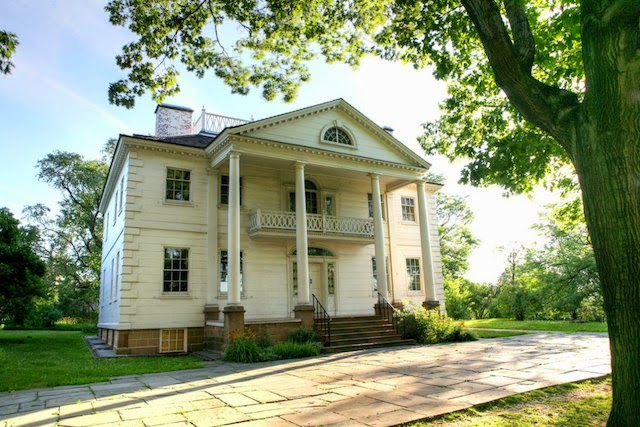
The Jumel Mansion - Manhattan

I’m not going to tell you too much about this place. I went there in 1964, just after my Mom had read about it in the newspaper. She was like that; she’d read something interesting, clip it out and the next thing I knew we were in the car and my father would be driving us to see it.

My wife is like that, too. I’m more of a drive by and see something, stop and look at it. It might seem more spontaneous, but I come up with less things than either my Mom, or Sue. So, their method is obviously a more fruitful track.

Without looking anything up I remember the story like this; Madame Jumel was the richest women in Colonial America due to some circumstances involving marriage and death. In those days that’s how it worked for women. They married as well as they could and then hoped for the early demise of the husband. Then she was free to marry the stable hand if she chose to. But, it worked both ways. George Washington married up, so to speak, when he tied the knot with Martha.

Anyway, Madame Ju
mel was involved with two men; one of whom I believe was Alexander Hamilton; but I’ll check that before I wrap this up. This is just my preliminary memory of the house and the things we were told on the tour.

At the time of our visit there had been a ghost scare at the mansion. A group of school children had gone on a field trip to see the house. When they were assembled on the front lawn a figure appeared on the upstairs balcony screaming at the children; and their very frightened teacher. No explanation was ever uncovered for the bizarre incident; other than the “ghost” screaming that the kids were making too much noise.

When we visited about a month later the docent showed us some of the window panes which had been etched upon with the signatures of either Madame Jumel, or one of her family. I don’t remember exactly. I do know this; that prior to the 1960’s the house was in disrepair and the local residents in Harlem had broken a good many of the windows.

But you could readily tell the original wavy panes from the new replacements. And these were the ones which had writing on them. The odd part was that the name and handwriting were from one particular person who had been dead too long to have done the etching on a few of the panes.

The house is on something like 160th Street in Nicholas Park. The Alexander Hamilton residence is barely a mile south of that on 141st Street, where it was relocated in the early 2000’s. It is still within the original 34 acre tract of land which Hamilton called home.

Okay, so now I will look on line for a picture of the house and a link which will tell the whole story. What you have read is merely the memory of a 10 year old kid. I’m looking forward to reading the whole story. Hope you’ll join me… here’s a great link with photos of every room.

The one of the mannequin reminded me of the fright I had when we came up the stairs to the second floor. The bedroom pictured with the mannequin was positioned in such a way that when you turned at the top of the landing you were looking right at it. As a 10 year old expecting a ghost to jump out at any minute, it did the trick and scared the hell out of me!


Thursday, November 6, 2014

Cab Calloway Live at the Cafe Zanzibar (1943-1947)

There are few live recordings which really capture performances successfully. This is one of those. Recorded at the Café Zanzibar in New York City this collection of some of Cab Calloway’s greatest live musical performances seem to come to life. The closest thing to the live energy captured on this disc would probably be James Brown Live at the Apollo, which was recorded in 1962. And although it is recorded in mono the re-master of these numbers is flawless.

These are not the songs most people think of right off hand in connection with Cab Calloway at the Cotton Club, which had closed just a few years before this recording was made at the Café Zanzibar. In many ways the Zanzibar came to replace the Cotton Club as the musical Mecca in midtown Manhattan at 49th Street above the old Winter Garden.

Originally called the “The Frolic” the club had such a bad reputation that most performers at the time referred to it as a “jinx joint.” All that changed on July 1, 1943 when the club opened under new management with Ella Fitzgerald headlining the first show. The new club also had a stated policy of hiring the best of the African-American performers of the day. Louis Armstrong, Count Basie, The Mills Brothers, Pearl Bailey and even Bill Robinson were regularly featured stars.

These were the days when the white folks would see the show at the Zanzibar and go home by about 2 AM. That’s when the performers headed back uptown to Harlem where they swung the rest of the early morning hours away at the smaller venues located there. Bear in mind as you listen to this album that you are probably being short changed a bit, although you won’t notice let alone mind. There are no recordings of those late night jam sessions anyway, so this is about as close as you will ever get to hearing them.

The tracks contained on this disc run from “We the Cats Shall Hep You”; 2 different versions; “Russian Lullaby” by Irving Berlin. “Lamar’s Boogie” and “Everyone Eats When They Come to My House “are two fantastic numbers which will have you swinging from the very first bars. “Afternoon Moon” by Duke Ellington gets a wonderful workout at the hands of Cab Calloway, as does “That Old Black Magic”.

Even if your only previous knowledge of Cab Calloway is limited to “Minnie the Mooch” or “Reefer Madness” this collection will not disappoint you at all. If anything it will have you listening harder than ever to the unique sounds of one of the “heppest” of the “hep cats” that ever graced a stage. As a matter of fact you don’t even need to be a jazz fan to enjoy this recording. It will swing you.

Tuesday, July 22, 2014

Jackie "Moms" Mabley

Jackie “Mom” Mabley was the Minnie Pearl of the old Chittlin’ Circuit. There’s only one big difference between the two; “Mom” came first by about 20 years. She appears to have hit the circuit sometime in the early 1920’s, arriving in Harlem at the height of the Cotton Club and everything else which came to symbolize a vibrant Black Renaissance; Langston Hughes, Cab Calloway, Louis Armstrong, and the list goes on and on.

Whoopi Goldberg narrates and appears in this lovingly made documentary about the life of one of show businesses arguably most beloved comediennes. Harry Belafonte, Bill Cosby, Quincy Jones, Billy Mitchell and a host of others, all reminisce about, and add individual bits of knowledge concerning “Moms” and her sometimes not so clear biographical background.

But one thing is sure in all of their minds; this little woman with the big heart was one the most unusual, and outspoken of performers to come down the pike. And to have done this as a woman during the time period in which she lived, made the journey; let alone the actual feat; remarkable to say the least.

Raped twice and forced to give up both children, she never really had another man. She was an un-closeted Lesbian off stage; even dressing as a man and squiring beautiful young women with her wherever she went. Off stage there were no house dresses and funny hats. There were 3 piece suits and gold watch chains, with a fedora to top it off!

I first became aware of “Moms” through the magic of the Merv Griffin Show, which aired after school. She fascinated me with her stories; she told stories more than she told jokes. Her stories always touched on the human condition; as well as politics.

Here again was a woman way ahead of the curve. But armed in that housedress, with no upper teeth in her mouth, speaking from beneath a floppy hat, she could; and did; say whatever she wanted to say. Sometimes the white audiences didn't know if they were being made fun of or not. Black audiences loved her because she could say what they were thinking, and say it on the television!

“Moms” was born in Brevard, North Carolina years before many of the comedians she has influenced, right down to the present day. Arsenio Hall, Kathy Griffin, Joan Rivers, Jerry Stiller and Eddie Murphy all appear in this film to share the influence which she had upon them.

If you have never heard of “Moms” before, then you need to hit You Tube and then get this HBO biopic to catch up with the rest of the world. Here’s something to start you off;


Monday, September 24, 2012

Cab Calloway - "Minnie the Moocher" (1931)


One of the greatest bandleaders of all time, Cabell “Cab” Calloway III was born on Christmas Day 1907 in Rochester, New York. It was a fitting day for him to have been born;  a day when people exchange presents; for with his inimitable style he has left us all the gift of his music.

One of his best known numbers is the rousing “Minnie the Moocher”, which is really a variation on the old “call and response” songs which were popular with African-Americans as far back as the days of slavery, when the music was used to accomplish work in unison. It was also a hallmark of early African-American Christianity. In the rural churches which sprang up in the black community after the Civil War, there was often a shortage of hymnals and prayer books. The preacher would say, or sing, a line from a prayer, or hymn, and the congregation would answer back in kind.

“Minnie the Moocher” is an example of how gospel influences would spill over into popular music, much as it did again later with the advent of rock and roll. The lyrics are said to be based on “Willie the Weeper”, while the melody is based on “St. James Infirmary”, a blues standard of the era.
This version of the song was performed on television in the early 1950’s. There are older, and even better, versions of this song on You Tube, but for some reason blogspot will not accommodate their download. And while you’re googlin’ around, don’t forget to look at “Reefer Man” by Cab Calloway and His Harlem Maniacs. This was one of the best scenes in the 1933 film “International House” with W.C. Fields. Never mind, here it is;

Tuesday, February 7, 2012

"Red Summer" by Cameron McWhirter

The summer of 1919 would become known as the Red Summer, not for the Communist scare sweeping the nation under the heel of the Palmer Act, but for the red blood of African-Americans, coast to coast, who were beaten, stabbed, shot and hung, from Connecticut to California.

Imagine coming home from war after having served your country and being denied the rights of a full citizen as a reward for your efforts. In the summer of 1919 African-American veterans of the First World War, during which they had shown supreme courage in some of the longest fighting of the war, earning more medals than their white counterparts, were faced with exactly that.

In the first part of the year, African-American troops returning from France marched up Fifth Avenue and through Harlem, with crowds, black and white, cheering all the way. Savoring the moment was a good idea, as the camaraderie wouldn't last long.

By July of 1919 the United States would be gripped by a wave of fear and paranoia. First there was the Red Scare engendered by the Communists, which prompted the infamous Red Act, which stifled political dissent and saw many Americans imprisoned for their belief in a different political system. On top of that there were the Unions, with their attendant violence, making their way across the land, further fueling the fears of political change.

But the straw that broke the camel's back was the expectation of thousands of African-American Veterans; men who had fought to preserve the system now under fire from the Unions and Communists; that they would be free at last from the yoke of Jim Crow laws, which had proliferated in the days after the Civil War. Alas, it was not to be. Instead, these brave men received some of the most brutal treatment in the history of the nation.

In many cases these men were victimized by the very soldiers that they had served with overseas. The white Veterans could not stand to see the African-American Veterans receive the same accolades as themselves for their service. This attitude, which begat the wholesale violence of that summer, was not confined to just the South, but spread like wildfire across the entire nation. Rumors and outright lies were the cause of most of the violence.

As Mayors and Governors attempted, in some cases, to quell the violence, politics entered the fray. These politicians, who wished to be re-elected needed to choose a side, and they did so quickly, mobilizing the local Police and National Guard units to quell the violence, mostly at the expense of the victims, who in many cases would not have the right to vote for almost another 50 years.

But something different was beginning to happen in America; African-Americans were starting to fight back. They had fought for the liberty of all Americans, including themselves. From this point on, there would be no turning back. The bloody summer of 1919 would give life to the Civil Rights Movement, and though it would take the better part of the 20th Century to accomplish the goals set forth by its members, the long march toward equality had begun in earnest.

Carefully researched, with 60 pages of notes on the sources used in writing this book, Mr. McWhirter has given us a complete and accurate picture of just what it took to spark the fire which would lead to the quest for racial equality in America.

Wednesday, February 9, 2011

"Harlem" by Jonathan Gill


From the silver tipped wooden leg of Peter Stuyvesant, which was given to him as a reward by the East India Company for continuing to fight, even after his leg was shot off, to Jan Rodriquez, a Portuguese seaman who went to live with the Rockaway Indians, fathering the first mixed race child in America, this book will disavow all you think you know about the early Dutch in New Amsterdam. It will also give you a whole new perspective on Harlem, and it's journey on the way to becoming a bastion of African-American Culture in the early years of the 20th Century.

It is still too early in the year to proclaim this book as the must read for 2011, but this sweeping history of Harlem ,which rivals the scope of the 1999 release of Edwin Burrows' and Mike Wallace's "Gotham", will certainly be in the running.

From Henry Hudson's first step ashore at what is now 130th Street in Harlem (and you thought he went ashore at the Battery) to the Revolutionary War, when Harlem was a small village and considered the "country", through the War of 1812, the Civil War and right on through the 20th Century, each page will surprise you with the richness of the history you didn't know.

Some of the misconceptions that are righted in this fascinating book concern the Lower East Side. We all have this impression that the Marx Brothers, Rogers and Hart, and a host of other entertainment figures, came from the Lower East Side. Not true. The Marx Brothers, as well as Rogers and Hart, and Oscar Hammerstein all came from Harlem. Even the original Little Italy was located in Harlem.

The Manhattan Project, which had it's beginnings in a warehouse adjacent to Columbia University is also represented in this treasure trove of history. Carefully researched and well written, this book will entertain you on so many different levels, that I hardly know how to begin a coherent review. The history of the tenement, and how it came into being, is a rare look into the background of early urban real estate and the forces which drove it.

The Christmas Riot of 1901, which began when a group of white Irish youngsters attacked an old Negro drunk, who was then defended by a pasing white man, sparked the riots that re-drew the color line in Harlem. Prior to the riot, Harlem, like the rest of New York, was divided into ethnic neighorhoods. There were Irish, German, Spanish, Jewish and Italian areas, each with it's own set of rules and rituals. The Christmas Riot began the ethnic change, and also sparked a cultural revival of the local arts scene. This was the era of Langston Hughes and Du Bois; the so-called Harlem Renaissance. It is one of the most exciting portions of the book.

The narrative follows the history of Harlem from Henry Hudson through the present day and it's hopes for the future. Along the way you will be introduced to such luminaries as James Europe, the bandleader turned soldier in the First World War. He enlisted over 2,000 men from Harlem, forming them into the "Harlem Hellfighters", an all black group that included Bill "Bojangles" Robinson. This band of soldiers trained in the streets, with brooms in lieu of weapons. When they arrived in France they introduced the people to jazz before spending 191 days in the trenches, longer than any white battalion in the war, on either side. They were also the only regiment to continue to move forward during that time, never giving up one single foot of the ground that they fought so hard to gain. They even amassed an extraordinary 171 Croix de Guerre's and Legions of Merit.

Modernist painters, gangsters, politicians, criminals, prostitutes, actors and prize fighters are all represented in this fantastic compilation of what made Harlem the unique Mecca of African-American culture that it became, and continues to be.

Monday, July 5, 2010

"Original Gangster" by Frank Lucas


From the very first page this book keeps you riveted to every word. The story opens in 1936 North Carolina on the morning that three white men, Ku Klux Klan members, come to the Lucas home and kill his 13 year old cousin, Obadiah. The crime was typical, he had looked at a white woman. For this, they blew his head off.

What follows is the real life story of Frank Lucas, notorious for decades as the reigning boss of the drug trade in Harlem; protege to "Bumpy" Johnson, the Al Capone of Harlem. This is a rare and fascinating look behind the African-American organized crime scene from the 1940's through the 1970's. It included drugs, gambling and prostitution. Flavored with many underworld characters, among them "Detroit Red", later to be known as Malcolm X, the book takes in politics, the code of the streets and the corruption that allows it all to exist, unhindered.

The book begins with a short dedication, admonishing the reader to stay in school, get a degree and not to follow in the path of it's author. For anyone who has seen the film "American Gangster" with Denzel Washington and Russell Crowe, this book will seem familiar. It should. That film was a synopsis of the life of Frank Lucas and his relationship with Bumpy Johnson, his mentor. This book offers so much more. This is the real story, told by the man who lived it. No special effects, just the words, plainly written to chronicle a life spent hustling to the top.

Written a few years after the release of the movie, the reader cannot help but wonder if Mr. Lucas saw the film and then decided to write the book to set the record straight. I believe he did.