Showing posts with label American History. Show all posts

Thursday, July 11, 2024

"1913 Massacre" - Woody Guthrie


Take a trip with me in 1913,
To Calumet, Michigan, in the copper country.
I will take you to a place called Italian Hall,
Where the miners are having their big Christmas ball.

I will take you in a door and up a high stairs,
Singing and dancing is heard everywhere,
I will let you shake hands with the people you see,
And watch the kids dance around the big Christmas tree.

You ask about work and you ask about pay,
They'll tell you they make less than a dollar a day,
Working the copper claims, risking their lives,
So it's fun to spend Christmas with children and wives.

There's talking and laughing and songs in the air,
And the spirit of Christmas is there everywhere,
Before you know it you're friends with us all,
And you're dancing around and around in the hall.

Well a little girl sits down by the Christmas tree lights,
To play the piano so you gotta keep quiet,
To hear all this fun you would not realize,
That the copper boss' thug men are milling outside.

The copper boss' thugs stuck their heads in the door,
One of them yelled and he screamed, "there's a fire, "
A lady she hollered, "there's no such a thing.
Keep on with your party, there's no such thing."

A few people rushed and it was only a few,
"It's just the thugs and the scabs fooling you, "
A man grabbed his daughter and carried her down,
But the thugs held the door and he could not get out.

And then others followed, a hundred or more,
But most everybody remained on the floor,
The gun thugs they laughed at their murderous joke,
While the children were smothered on the stairs by the door.

Such a terrible sight I never did see,
We carried our children back up to their tree,
The scabs outside still laughed at their spree,
And the children that died there were seventy-three.

The piano played a slow funeral tune,
And the town was lit up by a cold Christmas moon,
The parents they cried and the miners they moaned,
"See what your greed for money has done."

Thursday, November 24, 2022

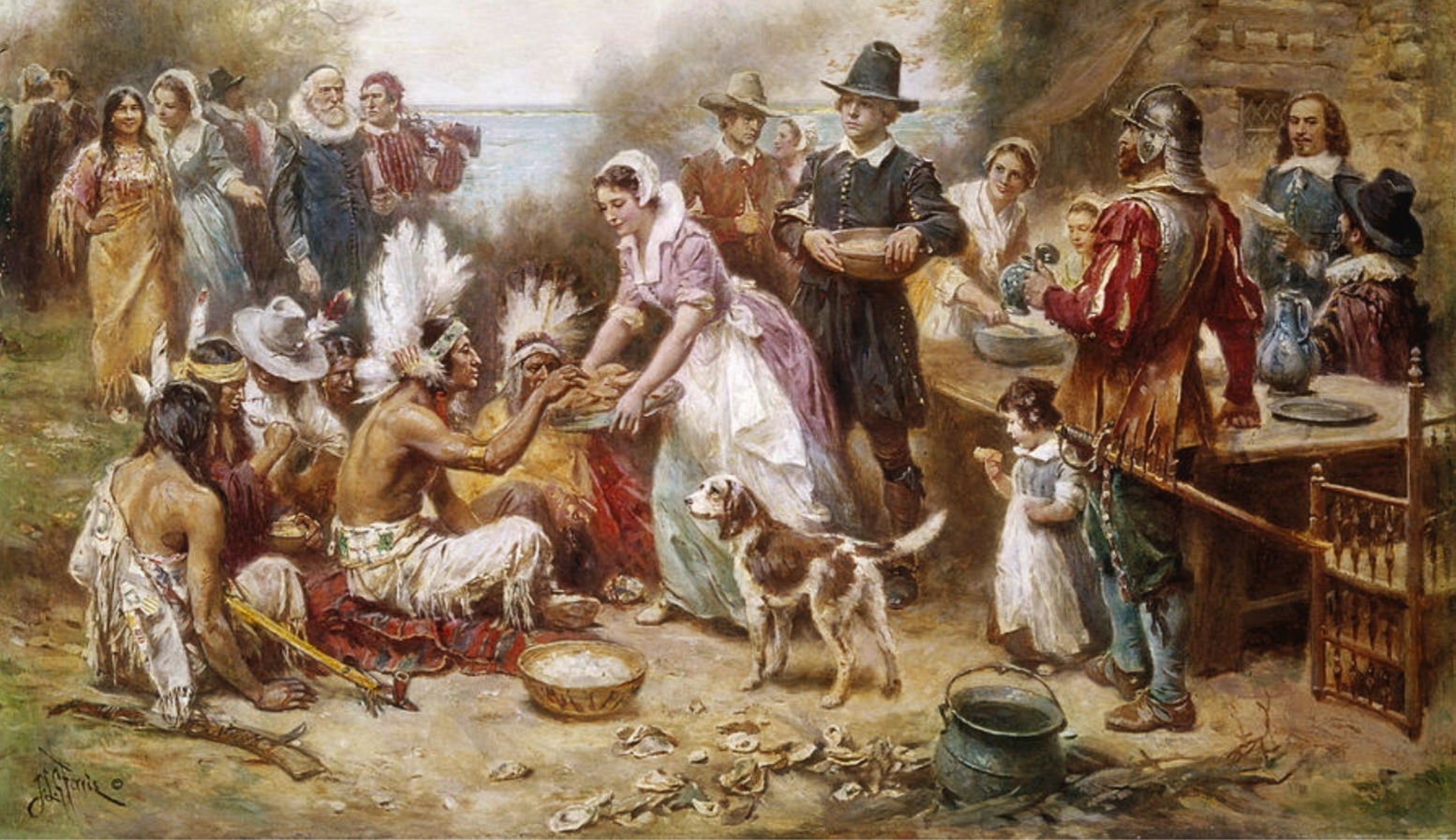
"Thanksgiving Day 1621" - Jean Leon Jerome Ferris


 "Thanksgiving Day 1621" was painted by Jean Leon Jerome Ferris in 1915. It supposedly depicts the Pilgrims at New Plymouth Colony in Massachusetts.

​Ferris was a 19th-century painter who was primarily known for painting 78 scenes of significant events from American history. He was born in Philadelphia in 1863.

Among his most known works are "The Landing of William Penn" and "The Fall of New Amsterdam." His paintings have come to be criticized for their idyllic versions of the events they puport to show.

That aside, he was painting what was known as the truth at the time he created the paintings. So, I still enjoy them for their perspective and color.

Happy Thanksgiving to all my friends and I hope that your Thanksgiving will be as idyllic as Mr. Ferris' paintings. Enjoy the holiday, friends, family and food. And if you are traveling, be safe!


Thursday, April 23, 2015

Lincoln Stories - 2 Favorites

I love Lincoln. The stories of his youth and physical prowess abound, most untrue, but inspiring nonetheless. The first one was in the book "The Case of Abraham Lincoln" by Julie M. Fenster, which I have reviewed here before. The second one is an old story that I read sometime as a kid, somewhere. Hence I have not backed it up with a source. Both stories are emblematic of the man, and the times in which he lived.

‘Tis said that in his younger day, he made a vow that if he should ever find a man uglier than himself, he would shoot him. One day while rambling over the hills with his rifle in his hand, in search of game, he met a man who was exceedingly ugly; immediately he cocked his gun and took aim, but upon being asked by the stranger what he was going to do, if he was going to murder him, Lincoln lowered his gun, told the stranger his vow and that he must prepare to meet his fate.

The stranger, after eyeing Lincoln for a while and scanning him from head to foot, exclaimed,; “Well, if I am uglier than you, I don’t want to live- so shoot me!”

Source: Iota: pen name, Illinois Correspondence, Missouri Republican, June 25th, 1856 page 2.

Abraham Lincoln was riding on a train when the man next to him lit a cigar, fouling the air about him. "Excuse me sir," said Lincoln, "but your cigar smoke is drifting into my area and I am having a frightful time breathing. Might not you extinguish it?" The man replied that he had paid for his seat, and if the smoke from his cigar was drifting into Lincoln's area that was his problem, but he intended to smoke his cigar.

Lincoln produced a small pistol, which he aimed at the man's head, saying as he did, "I, too, have paid for my seat, and I wish to fire my pistol. If the bullet from my gun strays into your area, well that's too bad." The man extinguished his cigar.

Apocryphal- no source.

Tuesday, November 19, 2013

"Hail Columbia" - Our First National Anthem


For years I thought this song was called “Rally Round the Liberty Tree.” As a child I always heard that extra word in the chorus, and somehow it became the title in my mind. It wasn’t until I was watching the mini-series on John Adams that I noticed that the words were wrong. That’s a joke- I mean that I had the words wrong.

I love the Star Spangled Banner; especially the history behind the writing of it; but sometimes when I think about it, and realize that it wasn’t our National Anthem until 1931, I find myself looking back at songs like “Hail Columbia” and “America the Beautiful” and wonder how it was that we didn’t have a National Anthem sooner than we did.

But, as much as I prefer “Hail Columbia”, simply because it was written at the time of our nation’s birth, rather than some 25 years later at the Battle of Baltimore in the War of 1812, I would never change it. How would we ever play baseball without it? Can you imagine, even for a moment, 70,000 people or more, singing “Hail Columbia” before the game? 

That being said; let me briefly make the case for “Hail Columbia” as the true National Anthem. First of all, it was widely considered to be the National Anthem up until the time that “The Star Spangled Banner” was designated as such in 1931. The song is wholly American in composition, unlike the “Star Spangled Banner”, which was written by Mr. Key as a poem and later set to an old British air.

By contrast, Joseph Hopkinson wrote the poem, which was added to Phillip Phile's music. Both were Americans; one an immigrant and the other native born. Joseph was the son of Francis Hopkinson who was personally known to General Washington from the War for Independence. This allowed him to send the words and music to Washington in 1798. The lyrics were the same as the General had heard at his first inauguration in 1789, but this time the music was different. The original title had been called “The President’s March” but was now billed as “Hail Columbia” due to a change in the words by Mr. Hopkinson.


Just as with the “Star Spangled Banner” there is an interesting “backstory” here as well. It involves an actor named Gilbert Fox, who wanted to find more rousing lyrics to go with the “President’s March.” He had chosen the song for the debut of a benefit concert; I bet you thought that sort of thing began with Bangla Desh; which was only days away. The concert was undersold and slated to be a losing proposition unless he could come up with something new and exciting.

On a Sunday afternoon he went to see Judge Hopkinson and asked for his help in composing a new set of lyrics. When the actor returned the next day, the song was finished.

Mr. Fox was able to open his show on time, the following Wednesday April 25, 1798 at Philadelphia’s New Theatre. The song was a show stopper, calling for 12 encores, with the audience quickly learning the words and joining in on the chorus. This was clearly a song of the people.

The scene above, from “John Adams” is pretty much true to life, as only a few nights later, President Adams and some of his cabinet; then based in Philadelphia; caught the show.

Interestingly, the song has survived as the entrance march for the Vice President of the United States, and is played whenever he leaves or arrives, much as "Hail to the Chief" is for the President.

“Hail Columbia” by Philip Phile/ Joseph Hopkinson

 Hail Columbia, happy land!
 Hail, ye heroes, heaven-born band,
 Who fought and bled in freedom's cause,
 Who fought and bled in freedom's cause,
 And when the storm of war was gone
 Enjoy'd the peace your valor won.
 Let independence be our boast,
 Ever mindful what it cost;
 Ever grateful for the prize,
 Let its altar reach the skies.

 Firm, united let us be,
 Rallying round our liberty,
 As a band of brothers joined,
 Peace and safety we shall find.

 Immortal patriots, rise once more,
 Defend your rights, defend your shore!
 Let no rude foe, with impious hand,
 Let no rude foe, with impious hand,
 Invade the shrine where sacred lies
 Of toil and blood, the well-earned prize,
 While offering peace, sincere and just,
 In Heaven's we place a manly trust,
 That truth and justice will prevail,
 And every scheme of bondage fail.

 Chorus

 Behold the chief who now commands,
 Once more to serve his country stands.
 The rock on which the storm will break,
 The rock on which the storm will break,
 But armed in virtue, firm, and true,
 His hopes are fixed on Heav'n and you.
 When hope was sinking in dismay,
 When glooms obscured Columbia's day,
 His steady mind, from changes free,
 Resolved on death or liberty.

 Chorus

 Sound, sound the trump of fame,
 Let Washington's great fame
 Ring through the world with loud applause,
 Ring through the world with loud applause,
 Let every clime to freedom dear,
 Listen with a joyful ear,
 With equal skill, with God-like power
 He governs in the fearful hour
 Of horrid war, or guides with ease
 The happier time of honest peace.

 Firm, united let us be,
 Rallying round our liberty,
 As a band of brothers joined,
 Peace and safety we shall find.

Monday, June 3, 2013

"Out of Order" by Sandra Day O'Connor (2013)

The most remarkable thing about this book is that it has never been written before; but then again, we never had a Supreme Court Justice like Sandra O’Connor before either. An accomplished author, the Honorable Justice has taken all of the tales about the Supreme Court; its history, it’s members, it’s legends and tall tales; and place them all in one book.

With the same style and dry sense of humor which marked her previous memoirs, the Justice has written an account of the daily workings of the Supreme Court in the 21st Century, and how those changes reflect the changes of our constantly changing nation. The Court is really kind of a mirror of whom we are, and if we don’t like what we see, then we have to make the changes ourselves.

History buffs will enjoy all of the minutiae in the book, as well as some funny stories about the Justices themselves; both living and deceased. Some were liked by their colleagues, some were loathed. The important thing being portrayed here is that the Justices are just people, entrusted with the care of the Law in our nation, and as outlined in the Constitution they are sworn to uphold.

Exploring the appointments of the various Presidents lends a unique insight into history. There have been only 3 Presidents who never made an appointment to the Court. There have also been issues which the Court has come head to head with the Executive branch in their attempt to interpret the meaning of the law under our Constitution.

Sometimes they have gotten it wrong, as in Plessy v Ferguson, the so-called “separate but equal” ruling in the late 19th Century. That mistake stood for 50 years, or more, but the point is that it was corrected. We live in an elastic nation, and Justice O’Connor has written a book that does our Court system, and the people who have set on the bench, a great service in making them appear more “human” than they have been portrayed before. This was a very quick and enjoyable read.

Friday, February 22, 2013

Happy Birthday George Washington!


Back when I was a kid we celebrated George Washington’s birthday as a separate holiday; as we did with Abraham Lincoln’s birthday. There was a special quality about having the day off in the middle of the week that is lacking in the combined holidays, resulting in the 3 day weekend we now refer to as President’s Day.

First off, a little bit of trivia. Washington was not born on the 22nd of February 1732.  He was born on February 11, 1731, over one year earlier. In 1731 we were still using the old Annunciation Style calendar which was woefully outdated as compared to the science of astronomy. It wasn’t until 1752 that the British government switched over to the new Gregorian calendar under the provisions of the New Style Act of 1750. I actually learned this is in 5th grade.

Calendars have changed many times throughout the history of the world. The earliest calendars were based upon observations of the moon, which was the closest and brightest thing visible to the ancients. The lunar calendar sufficed for thousands of years and served the basic purpose of marking time. Seasonally, there were adjustments necessary due to weather which affected the planting and harvesting of crops; then came the Sun.

When Copernicus proved that the earth revolved about the sun; and not the opposite; it was an upheaval in accepted logic. But this was the beginning point at which human beings came to redefine their understanding;  and methods of; chronicling the passing years.

The Gregorian calendar is the most widely used of calendars due to the fact that it is secular and scientific in nature. It’s interesting to note that this calendar is based upon Copernicus’ observations, as it was only a few decades removed from the Spanish Inquisition, during which the very teachings of Copernicus were banned by the Church. That the church even accepted a calendar based upon the sun as a fixed object, with no religious significance in the keeping of time, was a tremendous event.

The main advantage of the Gregorian calendar is that it keeps most of the world on the same schedule; a feat which became of increasing importance as the world seemingly “shrunk” with the advent of the Age of Exploration and Industrialization. For the most part though, the world’s leading religions; including the Roman Catholic Church; still use an older outdated calendar in calculating the dates of religious traditions and ceremonies.

For instance, the Roman Catholic Church relies on the insertion of a correction each year in determining the dates of Good Friday and Easter. It doesn’t always coincide with the actual history, as Good Friday and Easter often fall before the Jewish holiday of Passover, the events of which had to have occurred before the Crucifixion of Jesus. The Jewish calendar is still lunar based; and much like the Chinese Buddhist calendar, it can get confusing.

Pope Gregory XIII signed a Papal decree on February 24, 1582 adopting the new calendar in Europe. The other European nations followed within the next couple of centuries, with the practice reaching America in the early half of the 18th Century, just in time for the birth of George Washington.

The switch from the Julian calendar to the Gregorian calendar may seem silly, as it is based upon only 11 minutes or so of difference in the time calculated for the earth to revolve about the sun. But over a period of time; centuries; this adds up considerably if not corrected. Something like 3 days in 400 years. When Gregory was Pope we had already slipped by 10 days since the Roman era. This made the spring equinox fall on the 11th of the March instead of the 21st, and it was still drifting further away from that fixed date; which had been set by the church centuries earlier. Since that date affected the timing of the Christian holidays, the Church decided to “fix” it.

There were 2 parts to the “fix”; the first being a change in the number of “leap years” observed every 4 centuries to 97 from 100. This was the idea of Aloysius Lilius, a Calabrian physician. While the shift from the lunar calendar to the solar based Julian calendar was a big step forward in keeping track of the passing years, the Gregorian calendar was an even further step in this direction.

There is much more involved in the history of the calendar which we use today as we further refine our time keeping methods with atomic clocks and “leap second” corrections. But, this is just a simplified account of how George Washington had his birthday changed by more than a year.

_______________________________

Hey,Rush Limbaugh! 

Rush Limbaugh is ashamed of America! Guess what? We're ashamed of Rush Limbaugh. The talk show host has, in the past, told all apologists for America to love it or leave it. He also promised to move to Canada if President O'Bama won the election in 2008. We're still waiting....

Monday, January 28, 2013

"The Presidents Club" by Nancy Gibbs and Michael Duffy (2012)


I've often wondered about the relationships between former Presidents; of either party; with one another after they have left office. Next to retired Five Star generals; like Eisenhower; ex-Presidents are one of the more unusual occupations leading to retirement. How do they keep in touch with one another? Have they always done so? And what do they talk about? This book is a wonderful insight into just that question.
Beginning with President Truman, who wanted to do a proper “turnover” of command with Eisenhower; who was snubbed by the General; the authors have done a very credible and organized job in presenting the story of the few men who have led our nation; in war and peace; and how their relationships have often helped to shape foreign policy and world opinion.

I have to confess that I originally picked this book up with an interest in only the Truman-Eisenhower feud. I wasn't expecting to read the entire thing, but found myself drawn in deeper with each chapter. I was fascinated by the whole Truman-Eisenhower affair; as I knew I would be; but I was also pleasantly surprised at the author’s ability to maintain my interest beyond that.

Briefly put, the Truman-Eisenhower feud began when General Eisenhower criticized; for political reasons; his ex- Commander General Marshall, who was a friend of President Truman’s and ex-President Hoover. Although the plan to feed Europe was known as the “Marshall Plan”, it was really the brainchild of former President Hoover, who had done this very thing once before, after the First World War, when he was Secretary of Commerce. His humility drove his desire to not have his name associated with the plan, so the honor went to General Marshall, who implemented it. Remember that Hoover; like Ike; was a Republican. But he was also friends with Truman, and together the two formed the President’s Club on the very day of Eisenhower’s inauguration in 1953. It wouldn't be long until Eisenhower joined the club, his ongoing feud with Truman notwithstanding.

As I've said, this was the most interesting part of the book for me, as I have wondered about the relationship between the two for many years; and through many books; without ever having read such a complete and informative account as I have in this book. The feud between the two men came to an abrupt end on the day John Kennedy was buried. Eisenhower had learned that Truman was staying at Blair House, across from the White House, and in the confusion no one had bothered to provide him with transportation to the funeral of the slain President. It was Eisenhower who phoned Blair House and made arrangements for Truman to ride with him to the funeral. The last time they had ridden together was in 1953, on the way to Ike’s inauguration. During that entire ride they had not spoken to one another at all. But by the end of this day, in 1963, the two would be friends again for the rest of their lives.

It would be easy for the sitting President’s to blame many of their current troubles on their predecessors, and to some extent, that is what the club is there to prevent. All of the former Presidents agree that a show of national unity; rather than an adherence to party loyalty; is the most important role which they each play after leaving office. Even Presidents Ford and Carter found common ground, after their terms were over, by dealing with the Middle East. President Carter even delivered Ford’s eulogy in 2007.

From foreign affairs to politics at home, there are very few men the sitting President can turn to for advice or counsel. Only a few men have held the position and know the pitfalls which await each and every move they might make. At times like these, the Presidents club springs into action, with telephone calls made in the middle of the night. I can’t help but wonder at how these conversations begin. In my mind, it goes something like this, “Hello, Mr. President? This is the President. I hope I didn't wake you. But I need some advice.”

Thursday, January 5, 2012

"Lincoln On War" by Harold Holzer

This may be the best book yet written concerning Abraham Lincoln. Actually, it is the closest thing to having Lincoln pen his own memoirs of the years between the War with Mexico and our own Civil War. In some ways it even eclipses the great 2 volume masterpiece by Carl Sandburg, which is considered by many, me included, to be the "Holy Grail" of books about our most mercurial President.

The War with Mexico is of great interest, as the annexation of the state of Texas, aside from having been accomplished illegally, added fuel to the fire that would eventually grow into the conflagration of full blown Civil War. Lincoln saw the annexation of Texas as a way for the Southern States to hold a majority in the Senate and Congress. This was at the time of the great debates concerning the Missouri Compromise, and the Fugitive Slave Act, both of which were mere band aids or attempts in vain, to stave off the bloodshed which was sure to come from the slavery question.

The author has let Lincoln speak for himself by using the President's letters and speeches to make his point. The book is laid out in a way which parallels the career and thoughts of our 16th President on all of the issues leading up to the Civil War. And once that war has begun, this correspondence gives us a new and keener insight into the thoughts behind the actions taken by Lincoln during the prosecution of the War Between the States.

Lincoln, at the outset, wanted only to ban slavery in the new territories being acquired out west. He had no intention of outlawing the institution itself. As late as in his first Inauguration speech, Lincoln was still not calling for the Abolition of Slavery in the Southern States, but only in the newly acquired territories. In his first Inaugural Address he spoke these words; "I have no purpose, directly or indirectly, to interfere with the Institution of Slavery in the States where it exists. I believe I have no lawful right to do so, and I have no inclination to do so." He had made this same declaration in earlier speeches and was re-quoting himself in an effort to allay the fears of the Southern States, which had already seceded from the Union in January of 1861.

By the time that Lincoln issued his duplicitous Emancipation Proclamation, which freed slaves in enemy territory only, the outlawing of slavery in the Southern States became the objective of the war. Previously the chief concern had been one of finances. Lincoln queried, on more than one occasion, whether it was right for the Southern States to leave the Union while keeping the forts and roadways which had been paid for by federal loans. These loans would have to be repaid to the banks, and Lincoln considered it to be an unfair burden upon the remaining states to bear the full brunt of their repayment.

This is an exciting book which lays bare many of the myths that have been pumped into us over the years; Mr. Holzer has presented a new side of one of our most well-known, but often misunderstood Presidents.

Monday, October 17, 2011

Poking Around Fort Dobbs

It's a beautiful time of year in North Carolina. The stifling heat of the summer has given way to a glorious autumn, with the trees changing colors faster than the squirrels scampering to hide food for the winter. Sue and I love to ride around and find things to look at. We have passed by the Fort Dobbs sign so many times in our 13 years in North Carolina, that state law now required us to make a mandatory visit. Well, that's not quite true, but we did decide to visit the Fort yesterday. It was closed.

Now, that's not as bad as one would think. Having arrived at the site of the Fort, we were greeted by an empty parking area and a deserted site. Fort Dobbs has no walls, or fortifications, it is simply the remains of the fort grounds, with a reconstructed homesite, and no gates. So we roamed around, soaking up a bit of sun while we did.

The Forts history dates back to 1755, when Governor Dobbs requested that a fort be built at the Western "frontier" of the state. It's hard to imagine that this was about as far West as most of the settlers from the East had come in 1755, but it is true. There were many settlers beyond that frontier, but they were strictly on their own. The area beyond this point was Cherokee country. The Fort was built for defense against Indian attacks from the Cherokees, who had aligned themselves with the French, in what became known as the French-Indian Wars.

The Fort was built in 1756 and stood as a garrison on the site. It was more like a big box type of wooden structure, with a roof, than a conventional fort. It housed 50 men.

The fort came under attack late on the night of February 27, 1760 by more than 60 Indians. The settlers suffered two casualties, and one death, while the reports indicate that 10-12 Cherokee were killed, or wounded.

Not much remains of the Fort, just some outlines in the earth where the garrison once stood. By 1761 the garrison was moved further West, and by 1766 Fort Dobbs was in total ruins. The land is pristine and virtually untouched since the days of the fort. I hope it stays that way.

For a quick overview of the site, and the role it played in local history, this link will take you to the official web site for Fort Dobbs;

http://fortdobbs.org/history-fortdobbs.htm

Saturday, July 23, 2011

"Lincoln for the Ages" Edited by Ralph G. Newman


The "stacks" of a local library hold more forgotten history than can be learned in a lifetime. History moves so quickly that often much of it is left behind. And many of these "lost" pieces of the great puzzle can often be found in the "stacks." I go there often.

In this long forgotten and obscure book, published in 1960, are the views and anecdotes relating to President Lincoln, written by 76 distinguished Americans of the time. Many of the stories told here, as in the instances of his law partnership with William Herndon, cast more light on the character of Abraham Lincoln than anything written about him since.

His legal expertise has never been questioned, as in the Patterson case, a murder trial. Lincoln was able to show the innocence of his client through the use of an almanac, proving that the Prosecution's witness was lying when he said he observed the killing in the light of the moon. The almanac showed that there was no moon that night, thus freeing his client.

The Lincoln-Douglas debates, which arose out of the Kansas Nebraska Act debates show his uncanny ability to turn the tables on the most cunning of opponents. Lincoln had previously argued both sides of the Fugitive Slave Act, winning for both sides in different trials of the same charge. Out of the fierce debate roiling the country concerning the Kansas Nebraska Act, Lincoln was able to rise to national prominence with his scathing oratory and homespun appearance, both of which he used like scapels.

The plot to kidnap him enroute to Washington, D.C. on the eve of his inaguaration is more fully explained here in 3 pages than anywhere else. The plan was to hold him for ransom, the release of the Southern States from re-joining the Union would be the price. The plot was uncoverd in Philadelphia, and folied in Baltimore.

During his Presidency, Lincoln learned to use the press to his advantage, encouraging them to visit with him often. He would usually greet them with a hearty, "What news have you?" He would then go on to grill them, and in the process gave out far less information than he received. His relationship with the press would become the launching pad for the Presidential news conferences, which were first held by his sucessor to the Presidency, Andrew Johnson.

Lincoln's foreign policy is largely ignored in light of the Civil War, but on that frontier he was most active, and astute. Knowing that England could easily ally itself with the South posed a tricky situation for Lincoln. He could not afford to fight them, which would haved tied up the naval resources necessary to fight the Confederacy, as well as run the blockade against privateers. Yet, when 2 Southern envoys were being transported via an English ship to London for a conference with the Queen, the United States Navy, without the President's authorization, seized the ship and imprisoned the men. Lincoln took this situation and turned it to his advantage. He released the ship, and later the men, with a word to the British that we would brook no meddling in the ongoing conflict. He then issued his controversial Emancipation Proclamation, turning our own Civil War into a moral cause which Britian already supported, thus turning them into an ally. Prior to this, Britian had already shipped 8,000 troops to Canada for insertion in the Civil War, intending to fight for the South. After the Proclamation these troops were withdrawn.

France was posing a problem as well. They had invaded Mexico, with promises from the Confederacy that they could gain a foothold in America if they would support the South. Lincoln solved that one as craftily as he did the British problem.

We have all been taught about "Seward's Folly", the seemingly silly purchase of Alaska from Russia. But what we weren't taught was the relationship of Russia at the time to France and England, with which Russia had just lost a war. She needed two things badly; the first was cash, hence the sale of Alaska. The second thing they needed was to get their navy into a safe harbor. Lincoln allowed them to moor their fleets off San Francisco and Norfolk, thus covering two perimeters with a seemingly neutral force at no expense to ourselves. The mere presence of the Russian fleet made certain that no country would attempt to intervene on behalf of the Confederacy.

In politics Lincoln had no equal. Confronted by men such as Salmon Chase, William Seward, Edward Bates, and Simon Cameron as rivals, he made them all members of his cabinet, where he could keep an eye on their political ambitions.

Lincoln never considered the South to have left the Union, so there simply was no provision in the Constitution for punative action against the Southern states after the war had ended. Thus, his last directive was to "Let 'em down easy." Evidently no one was listening, and the next 100 years would see the South mired in racial discontent and constant upheaval. Had Lincoln lived, this may not have happened.

This is a wonderfully enriching book for any Lincoln scholars to sink their teeth into. Remember, the only thing new is the history you don't know.

Wednesday, April 13, 2011

"Redemption" by Howard Fast


Howard Fast was one of America's most prolific authors. And the range of his work is truly phenomenal, encompassing Fiction, History and Religion. From the first time I read "April Morning", in 5th grade, the story of a young boy on the morning that the American Revolution began at Lexington and Concord, I was a fan. And over the years, although I have drifted almost entirely into non-fiction, his books have continued to draw me back as he explores new topics and interests. Hey, this is the guy who wrote "Spartacus."

This book, "Redemption", was written in 1999, just a few years before his death in March of 2003, at age 89. It is remarkably candid in it's exploration of the accidental relationship of Ike Goldman, a professor emeritus at Columbia University, and Elizabeth Hopper, a woman whom he meets while driving across the George Washington Bridge at about 3 AM. She is standing at the rail on the walkway, ready to jump. He, a widower of several years, is returning from a gathering of old cronies, talking law, politics, and smoking cigars. She is the battered and abused wife of a Wall Street tycoon, who will be found murdered very shortly after they meet. And the murder is committed with Ike's long forgotten pistol, which he hasn't seen in years.

This leaves two obvious suspects, both with ample motive, opportunity and time to commit the murder of the late Mr. Hopper. But is circumstancial evidence ever enough to be sure? Especially when it is a capital crime? As a professor of contract law, Ike must learn, with the aid of a former student turned defense counsel, to navigate the pathways of the justice system rather than the board room.

Mr. Fast did not just write simple novels. They can be taken at "face" value and make great reading. But the secret to his long and varied suceess as a writer has always been his ability to educate the reader along the way. The story is just a vehicle. The plot here encompasses Womens Right's, Faith, and the possibilities of fate accidently taking hold in one's life.

With a wedding between 79 year old Ike, and 47 year old Liz in the balance, the story takes on a whole new dimension, as Ike struggles with the seeming absurdity of love with a younger woman. Will his judgement, and integrity, be tempered by his emotions? Or will the simple logic of truth, which he has always taught, hold sway?

With supreme character development, as expected of Mr. Fast, the book takes on an urgency that will keep you turning pages. The court trial and jury summations are spot on to real life, leaving the reader just as unsure as in an actual courtroom, when the jury is really out.

Mr. Fast passed away in 2003, at age 89. He wrote until the end. I wish I had had the opportunity to thank him for the treasure of literature he has left behind.

Saturday, April 2, 2011

"Secret Lives of the First Ladies" by Cormac O'Brien


A very unusual collection of stories about the First Ladies, told in chronological order, this book is a terrific insight into the history that we never learned in school. The job of being First Lady is an arduous task, and at times, thankless. But at other times it can be a most rewarding position that allows some input into the affairs, and history, of our country.

Beginning with Martha Washington, who, as the first "First Lady", set the tone for all of the First Ladies to come, this book makes you realize that the story of the "Father of Our Country", without any mention of Martha,is one that is only half told. And that truth is evident throughout this book.

Originally Martha Washington was referred to as "Lady" Washington, a title that would define all the First Ladies until Dolley Madison, who had held sway over Washington during the Presidency of not only her own husband, James Madison, but also that of Thomas Jefferson as well. (He was widowed.) When she passed away in 1849 she was lauded as the nation's "First" Lady, and that designation became the basis for today's title.

And so it goes with the rest of this book, all the way through to Michelle Obama. These women were really quite remarkable, especially the earlier First Ladies, who often lacked the formal education and schooling of their husbands. Each woman who has occupied the position has contributed something admirable, or noteworthy, to our collective history. And so often, these contributions have been overlooked.

Our earliest President's had some of the most interesting wives, women who were sometimes raised on the frontier, as well as women who were the product of great wealth.

The author does a credible job at both enlightening the reader on the accomplishments, as well as the eccentricties, of this select group. Of course the book is filled with all kinds of trivia, which makes it all a bit more fun, but the real story is the role that these women have played in shaping this slightly crazy and unique country that we call home.

Tuesday, November 23, 2010

"Our Vanishing Americana" A Documentary by Mike Lassiter and Scott Galloway


I was pleasantly surprised to hear that Mike Lassiter and Scott Galloway, both local residents, were having a screening of their film, "Our Vanishing Americana", at the local Public School in Davidson this past Sunday. Originally published as a book by Mr. Lassiter in 2006, this beautiful collection of photographs, and their accompanying stories, were, with the aid of Scott Galloway, made into a wonderful film documentary in 2009. I originally ran across this book at the Library in Mooresville and saw the film last winter on TV1, a local municipal station. The whole idea of making a film from the book sprang from the simple act of Mr. Lassiter's having met Mr. Galloway. Sharing the same passion for these old stores propelled them to collaborate on the film. So they set off to revisit several of the places shown in the original book.

Utilizing the photographs of local "Mom and Pop" stores, Mr. Lassiter had drawn an impression of North Carolina that seems to disappear more quickly with each passing day. (Witness the old Fire Station on South Boulevard as a recent example.) It's what we do here, tear down the old buildings and landmarks, replacing them with corporate arenas that no one wants, or attends. Shopping malls, large and small, along with housing developments, dot the countryside where once there were beautiful, intimate towns and country stores. Some of these stores had been owned and operated for generations by the same families. There aren't that many left.

I am lucky enough to live in an area of the state that is home to a few of the stores highlighted in the book, as well as the film. The personalities of the people in the original photos seem to spring to life on the screen. And Mr. Galloway does a superb job in making that happen. He captures on film, that quality of light, and even the ambience of the places he films. With the added combination of Mr. Lassiter's narrative, the whole experience takes on a life of it's own.

The music that punctuates portions of the film is, for the most part, all homegrown. From "Country Roads" by native son James Taylor, to the rollicking sound of "Wagon Wheel" by Old Crow Medicine Show, the music is pure North Carolina, and speaks to the beauty of the area.

One of the best, and most poignant portraits in the film is the segment that deals with Hinckle's Market in Lexington. The store is in it's third generation, and while the current owner and his brother have often contemplated closing it, whenever a customer comes in and tells him that the town couldn't live without him, they simply keep on.

D.E. Turner's Hardware store, located about 15 minutes from my home, is featured in the film. I have purchased odds and ends there for over 10 years. I have bought as few as 4 screws there when necessary to complete a job. His Radio Flyer collection of toys is unequaled the area.

The whole point of this effort by Mr. Lassiter and Mr. Galloway, is not simply to sell nostalgia, but more importantly, to ask what we can do to preserve these stores for our children and grandchildren. And while we all understand the necessity of shopping for the best price, maybe we can step back a bit and buy some things from our local Main Street stores. Only by keeping the stores economically viable can we hope to keep them going for yet another generation. And the most important thing of all is that with each of these "mom and pop" shops that gets lost - we lose a little bit more of ourselves.

Here is the link to the site for "Our Vanishing Americana." Hurry up and take a look, it's going fast. And thanks to Mr. Lassiter and Mr. Galloway for a delightful treat on a Sunday afternoon.

http://ncamericana.com/

Tuesday, October 12, 2010

A Columbus Day Memory - 1958

This is me on Columbus Day 1958. Back then, especially in New York, Columbus Day was a big thing. There were parades, and schools and banks were closed. I don't remember if there was mail or not, but the point is that Columbus Day was a big deal. With the advent of revisionist history, coupled with the desire for more leisure time, Columbus Day became one of those "floating" holidays reserved primarily for Federal Employees. I was sad to see this happen over the years as I have some great memories of Columbus Day back in Brooklyn as a kid.

I remember waking up on the holiday and making a Columbus Day "tree" from the newspaper. This photo is of my attempt today to try and replicate that feat. This is the first time in over 50 years that I have tried this. Pretty simple to do. Just take the newspaper, open it to the center and start rolling it into a cone shape. When you are done, simply tape the bottom so that it does not unroll. Then, using a scissors, cut the newspaper from the top opening of the "cone", cutting downward, about 1/3 of the way. Then reach inside the top and gently pull the interior section up and out. If you do this correctly the tree will blossom before your eyes. After doing that, my brother and I would march around the living room, holding our "palm trees" as we did.

The signifigance of the palm tree was that it was the first tree Columbus would have seen when he landed in what he thought was America, but was actually Hispaniola. No matter. My favorite part of the Columbus story has always been his third voyage. That's the time when his group of ships insisted on leaving for Spain just before a low pressure system was due. Columbus, who was an average navigator, but a great meteorologist, cautioned against it. The others left more than 2 weeks ahead of him,and vanished in what we now call a hurricane. And when Columbus arrived in Spain, they were nowhere to be found.

Friday, October 1, 2010

Oleans Street - My Secret Walks

There are so many places in Brooklyn, New York, where I grew up, that can leave you wondering, at times, where you really are. Years ago, when I still lived there, I had a habit of walking each evening from about 9 PM until about 2 AM. On any given night you could find me wandering around the streets. It was my habit to walk the area bounded by Sheepshead Bay to the South, and Cortelyou Road to the North, where the subway leaves the elevated line and goes underground.

My meanderings East and West were from Ocean Parkway to Flatbush Avenue, with a customary stop at the Wyckoff-Bennett House, pictured above, on East 22nd Street. The house is from 1763 and used to face South, it was moved sometime around 1900. When I was really little, we lived on Bedford Avenue and Kings Highway. It was 5 long blocks, but not too far to keep us from going there on Halloween. They gave out old silver dollars. This was about 1959.

While in Kindergarten across the street at Public School 197, Ms. Gerber used to take us across Kings Highway (6 lanes!) to see the house and garden. She told us that George Washington had slept there and that these trees had seen him! When I got older and would take my nightly walks I used to enjoy standing beneath the huge old trees that adorned the sidewalk in front of the house. Their leafy canopies offered me shelter from whatever it was I was trying to walk away from. I would rest there and then continue on my nightly quest for, I'm not sure what.

One evening, late, it was after dark, I found myself on the quietest street I could ever have imagined. It was called Oleans Street and could have been a lane in a small country town. I have thought often of the darkness and quiet beauty of this street over the many years since I left Brooklyn. I've often wondered how it got there, slanted amidst the neat rows of numbered and alphabetized streets that make up most of the borough. And while browsing the site Forgotten Brooklyn.com yesterday I got my answer.

Oleans Street runs for 2 blocks between East 22nd and East 24th Streets, and diagonally between Avenues N and O. This came about as a result of Ocean Avenue being straightened. Older maps indicate that it was curved in several places until it became a main route that runs all the way to Sheepshead Bay. Oleans Street was, at one time, a part of Ocean Avenue. You can still see the overhead power lines for the old trolley in this picture.

The most beautiful thing about this area were the gardens. I was raised in an apartment, and although my father kept window boxes of geraniums, we had nothing like these beautiful lawns and flower beds, which adorned the homes around Bedford Avenue, as well as my beloved Oleans Street. So, this was a magical place that I have always looked back upon with secret affection. I just didn't think anyone else knew about it!

The streets of Brooklyn are a hodge-podge of history. The old Dutch names recall the times of the earliest settlements, some of which were in nearby Gravesend and Flatbush. I was never bored as a child, there was always somewhere to go, or something to see. The past still seemed present when I was a child.

I'm not sure why, maybe it's the change in the weather, but I find myself looking back, more and more these last few days, to Brooklyn and the past. And though I know I'll never go back there, at least for any length of time, a part of me will always be walking those same streets, drinking it all in and remembering those walks. Still looking for, I'm not sure what..

Tuesday, September 14, 2010

William Beanes and Francis Scott Key

I have always been the type that stops to read the historical markers on the side of the road. When I was an estimator, working in and around Wahington, D.C., I frequently went to the Prince Georges County Courthouse to obtain Building Permits and Deed information. Across the street from the courthouse was an old, and sometimes unkempt, grave which always intriqued me. One day, when I had some time to spare, I walked over to see it more closely and was surprised to find that this man, one Dr. William Beanes, was connected to, no make that, responsible for, the chain of events that culminated in Francis Scott Key writing "The Star Bangled Banner" some 196 years ago today. Let me tell you the story;

Dr. Beanes was born in Upper Marlboro, Prince Georges County in Maryland in the year 1749. He was the son of a prominent planter. Educated in Scotland at the University of Edinburgh, he became a Doctor and returned home to Maryland.

Still living at the time of the War of 1812, he resided in Upper Marlboro, around which some of the preliminary battles to seize Washington, D.C. were being fought in September of 1814. And this is where Dr. Beanes begins his intersection with history.

The British were foraging for food and supplies when they arrived at Dr. Beanes home. He identified himself as a Federalist, the Ameican political party which was vehemently opposed to the war with Britain. He even went so far as to let them take whatever they needed, and was so cooperative, that he was paid full market value for everything that the British took from him.

They then proceeded on their journey, leaving 4 men behind. 2 of these were "stragglers", who had become seperated from their units. The other 2 were deserters, and had they been caught by the British, would be hung.

The following day found Dr. Beanes strolling across his fields with American General Bowie when they noticed 2 men lurking nearby. These were the "stragglers." A short time later the deserters were captured as well and all 4 were held in Upper Marlboro. The news spread quickly and soon the British had sent a squad back to the town to collect the prisoners. They gave the town until noon the next day to produce them or else the entire town would be burned.

The next day the town gave them the "stragglers", who were after all, still enemies, but refused to give up the deserters. By this time they had been removed to Queen Anne County for safe keeping. When the British began to make preparations to burn the town, Dr. Beanes quickly offered himself in exchange. This was a remarkable man, who, at one moment is dealing with the enemy for provisions in a war to which he is opposed, the next moment finds him capturing the enemy and then aiding in hiding 2 of them before finally offering himself up in an effort to spare his town!

When the British left Upper Marlboro, a Mr. Weems and Dr. Hill rode to Georgetown, where Richard West, a friend of Dr. Beanes, contacted his brother-in-law, Francis Scott Key, a prominent attorney and also brother in law to Richard Taney. The trio were able to contact President Madison and he dispatched Mr. Key, along with the Presidents emissary for Prisoner exchanges, John Skinner, aboard the USS Minden to seek out the British Fleet and arrange for the release of Dr. Beanes.

Starting downriver from Baltimore the Minden located the British at the mouth of the Potomac, just as they were about to turn and head towards Fort McHenry and Baltimore. They had already burned Washington, D.C., and the capture of Baltimore would be another "feather in their caps."

The British were, at first, reluctant to release Dr. Beanes, and both Mr. Skinner and Mr. Key were apalled at the condition of Dr. Beanes, who was being held in solitary confinement and on reduced rations. But as affidavit after affidavit poured in from the British commanders in the field, attesting to Dr. Beanes fair treatment of the British, both General Ross and Admiral Cochrane agreed to his release. However, as Skinner and Key had been aboard too long, and heard too much about the British plans, all three would be held until the following day, when the battle for Baltimore would, presumably, be over.

That night the British sailed up river to Fort McHenry and the bombardment began. Throughout the night both Key and Skinner struggled in vain to see if the flag had been "struck", or lowered, indicating a surrender on the part of the Americans. But as the dawn broke, and the smoke cleared, Key could see "by the dawn's early light, what so proudly we hailed, at twilights last gleaming..." The flag was still flying when the British turned around.

The British may have managed to burn the White House and drive the government out of town, but they would not go on to win a victory in Baltimore, and they would lose the war. Although the Treaty of Ghent was signed on December 24th, 1814, word of the treaty would not reach America until February of 1815. By that time the British had lost The Battle of New Orleans, fought in January of 1815, which resulted in their unconditional surrender, and almost 150 years later inspire another, but quite different song, concerning the events there. But that's another story, and another blog....