Reviews of books that have held my interest. And things that happen along the way.
I have made it simpler to leave a comment. Just hit the comment selection and choose anonymous at the bottom- Or at my yahoo;
robertrswwilliams@yahoo.com
And let's not forget my friends at the Public Libraries!Most of my selections come from the Libraries listed on my sidebar. They are a great resource and a wonderful use of our tax dollars.
Have you hugged a Librarian today?
Showing posts with label Political Correctness. Show all posts
Showing posts with label Political Correctness. Show all posts
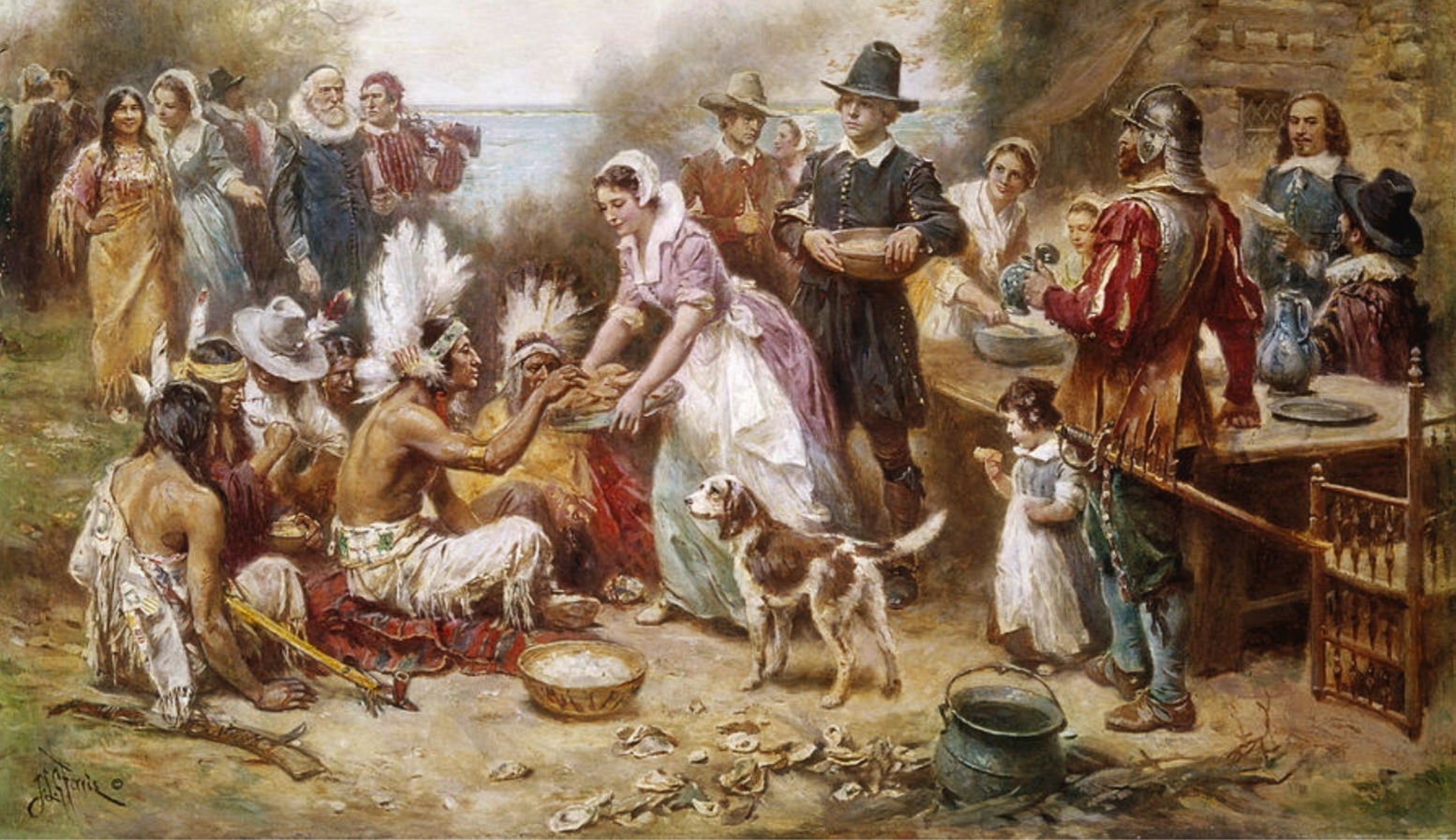
"Thanksgiving Day 1621" was painted by Jean Leon Jerome Ferris in 1915. It supposedly depicts the Pilgrims at New Plymouth Colony in Massachusetts.
Ferris was a 19th-century painter who was primarily known for painting 78 scenes of significant events from American history. He was born in Philadelphia in 1863.
Among his most known works are "The Landing of William Penn" and "The Fall of New Amsterdam." His paintings have come to be criticized for their idyllic versions of the events they puport to show.
That aside, he was painting what was known as the truth at the time he created the paintings. So, I still enjoy them for their perspective and color.
Happy Thanksgiving to all my friends and I hope that your Thanksgiving will be as idyllic as Mr. Ferris' paintings. Enjoy the holiday, friends, family and food. And if you are traveling, be safe!
If you are expecting anything remotely resembling a plot in
the following narrative, then you have come to the wrong place. And, if you are
expecting any sort of moral preaching, or political correctness, concerning the circus; and the Fat Man in particular; once again you will be disappointed, as
this is just a memory from April 1960, when I was not yet 6 years old and Uncle
“I” took me to the circus with my brother.
I have no illustration to post with this. Uncle I never had
a camera as far as I know, and though he literally spent hundreds of days with
my brother and I, there is not a single photo of us from any of these outings.
But the mind’s eye is the best camera of them all, and the images of Uncle
Irving are still sharp and clear; especially when I think of the story about
his encounter with the Fat Man.
If I was 5 and a half, then my brother was 7, and Uncle I
was somewhere around 65; his age changed with the document you were looking at.
Uncle I was about 160 pounds and maybe 5 foot 7 inches tall at the most. He was
no scarecrow; but neither was he a match for the Fat Man.
Now, in those bygone days before the politically correct
crowd got going, there was a side show at the circus which was nothing like
what you might see today. There were still remnants of the old Freak Show about
it and Uncle I simply followed the crowd as we herded into the old Madison
Square Garden for the show.
We soon broke away from that horde of crushed humanity and found
ourselves in an open area not quite behind the stands, but definitely not an
area usually open to the public. Uncle I was particularly adept at this sort of
thing. Since he knew just about everybody everywhere we went anyway, we were greeted
with friendly hellos wherever we went. I remember this day he introduced us to
several people, with my Uncle saying, “These are my niece’s children”, with definite
pride in his voice.
There were a few other people milling about, seemingly
concentrated in one area. We approached that scene and made our way up front
where the Fat Man had his trailer. This area must have been underneath the
seating area, and it was arranged with trailers that served as living
quarters for the people who comprised the acts which made up the circus. How
odd it must have been for these people to live “indoors” as it were, rather than
outside, which was the usual way the circus set up outside of the city.
The Fat Man was standing outside of his trailer and; accompanied by a man I assumed to be his manager; was fielding questions. "How
much do you eat for breakfast"; "what do you weigh"; and assorted queries of the
like, were being hurled at him faster than spitballs. To his credit he answered
every one of them with a gentle voice which belied his size.
The crowd was beginning to leave and Uncle I took us right
up to the big man and was introducing us when the Fat Man turned around and
stepped forward, his foot landing squarely against my Uncle’s shin and then
traveling downward until all 750 pounds of him were resting on my Uncle’s foot.
Uncle Irving never screamed; didn't even yell in pain. He just quietly
told the Fat Man that he was standing on his foot and could he please remove
the extra weight as he was with his nephews. The Fat Man looked terribly pained
and apologized profusely to my Uncle for hurting him. Then he did something
that has never left my memory; he asked Uncle I how much he weighed; which is
probably why I know that figure so well. When my uncle told him, the poor man felt even worse.
We saw the rest of the circus with Uncle I frequently
checking his increasingly swelling ankle. By the time we were headed home he
was limply noticeably. Still, he refused to show any sign of the pain and
discomfort he was surely in. Instead he made repeated jokes about the whole
incident and even told strangers on the subway that he had just come from Madison
Square Garden, where the Fat Man had stepped on his foot. He even showed off
his wound; more than once; to other, admiring passengers. I think he was actually proud of it!
Looking back on the whole thing now makes me smile. But, even if there is no lesson here for you, I
learned several lessons that day from both my Uncle and the Fat Man. From the
former I learned to accept discomfort, accept your limitations with pride, and even joke about them. From the latter I
learned humility, which the Fat Man showed by being truly concerned about what he had
accidentally done to a much smaller human being.
We learned this song in elementary school. The other day
I was playing it on guitar, when I stopped as I realized the words and their
full import. This song was sung far and wide when I was growing up, and in some
places it is still a staple of childhood rhyme schemes. I have no problem with
it, as the children singing it usually have no idea of what the lyrics mean.
Some folks even think that the lyrics are two separate songs.
The above live performance by Burl Ives is a bit out of
synch. I could have used another clip, but this one from 1964 shows just how
out of synch most of America was regarding race relations at the same time as
the country was experiencing massive racial unrest. The Civil Rights Act of
1964 had yet to be passed, and the events in Selma, Alabama were still a year
away.
Some folks have objected to this songs continued use in
schools due to the racial overtones of the lyrics. The main character is a
slave who tends to his masters every need. Some find that offensive. But listen
more closely and you will realize that this song makes sport of the master’s
dependence upon his servant, who actually may have played a small part in his own demise. The last verse is the best, and if you remove the quotation marks from the epitaph then the whole meaning changes. Instead of an epitaph it becomes a confession on the part of the servant.
As the world evolves, changes get made and things get
lost. I hope that the people who object to this song will stop and really hear
it for what it is; it’s a satire about the people who only think that they are
in charge, but haven’t got a clue. If they did, then the blue tail fly could
never have hurt them.
“The Blue Tail
Fly” by Elie Siegmeister and Walter F. Kerr
When I was a kid Foghorn Leghorn was my favorite Merrie
Melodies character. Well, actually, they all had their good points, but perhaps it
was because Foghorn seemed emblematic of what was happening in America at the
time in regards to Civil Rights. It was also the 100th anniversary of the
beginning of the Civil War. So, to me, Foghorn Leghorn “was” the Southern Dixiecrat;
and although in reality his ilk would repulse me; as a cartoon there was an
attraction borne of having seen this guy on the evening news.
In this 6 minute cartoon I’m not really sure who gets
lampooned the most; the Southerners or the “Hillbillies” who are represented by
chicken hawks, but are probably supposed to be African-Americans. But, at the
same time, they bear all of the trappings of the stereotypical “Hillbilly.”
So,
if you are offended by this type of humor, remember that this cartoon came out
just 2 years BEFORE “The Beverly Hillbillies” appeared on CBS, and which would
run for 7 more years after. The Andy Griffith Show had already begun its
classic run, and “Green Acres” wasn't even on the drawing board yet. At the same
time, most television shows were white, and shows like “Julia” were still almost
a decade in the future. And, it would be a full 10 years before Archie Bunker
made a fool of himself each week in your living room.
The voices in this cartoon are, of course, Mel Blanc.
Foghorn is hitchhiking south; presumably from D.C.; to spend the winter, being
pulled by a flock of birds. When he catches scent of the magnolias, he knows he
is back down South. Unfortunately for him, just as he is finished setting up
camp for the winter, “Elvis” and “Pappy”; the aforementioned chicken hawks;
catch his scent, and the race is on to see just who will be having who for
dinner.
Forget the political correctness, and enjoy this cartoon for
what it really represents. What is that? I’m not sure, but it looks an awful
lot like most of us to me.
This is a book I have been waiting for. In case you don't recall, Juan Williams, the talented Prize Winning Journalist from the Washington Post, was summarily dismissed from his post at NPR, where he had hosted a show for several years. His crime: he gave his opinion concerning the way in which "random" searches are conducted when boarding airplanes. He spoke his mind. And that of millions of other Americans, who in the wake of 9-11, have been understandably uncomfortable when on airplanes with traditionally dresssed people of the Islamic faith.
The usual reasoning employed to make you feel "wrong" in your thinking this way is based solely on the fact that the 19 hijackers on September 11th were not dressed traditionally, but rather in American style clothing. Of course they were! They didn't want to face any extra scrutiny while carrying out the acts of terror that had been planned by other Islamics who were dressed traditionally. This is so basic a concept it is hard for me to believe that those in charge of NPR can't see the foolishness behind their "politically correct" thinking.
I am not a big fan of NPR, I find them often to be merely the "flip side" of Rush Limbaugh. I prefer my news from other sources, eschewing commentary for real reporting. That's not to say that I don't support NPR in principle. And I have my own favorite columnists, whom I read in the newspapers. I welcome diversity of opinion as a way to form my own. So, that's why I read this book.
I expected some sort of diatribe concerning liberal bias, and assumed that this book was the bridge for Mr. Williams to cross over to the more lucrative Conservative side of the media. I was pleasantly surprised at what I read.
Mr. Williams has written a well balanced book about the lack of real political discourse in America today, and what it means for our futures. He explores the economic, as well as social, implications of a society where every word must be measured carefully in order not to offend. He takes both sides of the political spectrum to task in an orderly fashion, pointing out the follies of extremism, and the negative effect that "politically correct" speech has on an open discussion of anything. And that includes the current debt crisis, which has only been pushed to the sidelines pending the next election.
No matter how you feel about NPR, or Juan Williams, this book has much to say about the future of civil discourse in America. And it ain't pretty. It's like Pogo said, "We have met the enemy, and he is us!"