Showing posts with label Manhattan. Show all posts

Tuesday, April 7, 2015

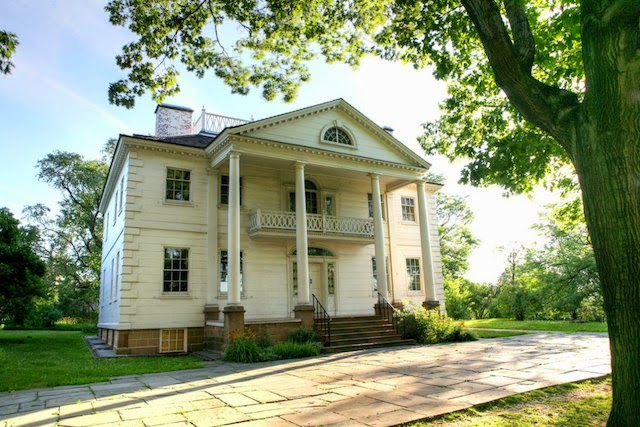
The Jumel Mansion - Manhattan

I’m not going to tell you too much about this place. I went there in 1964, just after my Mom had read about it in the newspaper. She was like that; she’d read something interesting, clip it out and the next thing I knew we were in the car and my father would be driving us to see it.

My wife is like that, too. I’m more of a drive by and see something, stop and look at it. It might seem more spontaneous, but I come up with less things than either my Mom, or Sue. So, their method is obviously a more fruitful track.

Without looking anything up I remember the story like this; Madame Jumel was the richest women in Colonial America due to some circumstances involving marriage and death. In those days that’s how it worked for women. They married as well as they could and then hoped for the early demise of the husband. Then she was free to marry the stable hand if she chose to. But, it worked both ways. George Washington married up, so to speak, when he tied the knot with Martha.

Anyway, Madame Ju
mel was involved with two men; one of whom I believe was Alexander Hamilton; but I’ll check that before I wrap this up. This is just my preliminary memory of the house and the things we were told on the tour.

At the time of our visit there had been a ghost scare at the mansion. A group of school children had gone on a field trip to see the house. When they were assembled on the front lawn a figure appeared on the upstairs balcony screaming at the children; and their very frightened teacher. No explanation was ever uncovered for the bizarre incident; other than the “ghost” screaming that the kids were making too much noise.

When we visited about a month later the docent showed us some of the window panes which had been etched upon with the signatures of either Madame Jumel, or one of her family. I don’t remember exactly. I do know this; that prior to the 1960’s the house was in disrepair and the local residents in Harlem had broken a good many of the windows.

But you could readily tell the original wavy panes from the new replacements. And these were the ones which had writing on them. The odd part was that the name and handwriting were from one particular person who had been dead too long to have done the etching on a few of the panes.

The house is on something like 160th Street in Nicholas Park. The Alexander Hamilton residence is barely a mile south of that on 141st Street, where it was relocated in the early 2000’s. It is still within the original 34 acre tract of land which Hamilton called home.

Okay, so now I will look on line for a picture of the house and a link which will tell the whole story. What you have read is merely the memory of a 10 year old kid. I’m looking forward to reading the whole story. Hope you’ll join me… here’s a great link with photos of every room.

The one of the mannequin reminded me of the fright I had when we came up the stairs to the second floor. The bedroom pictured with the mannequin was positioned in such a way that when you turned at the top of the landing you were looking right at it. As a 10 year old expecting a ghost to jump out at any minute, it did the trick and scared the hell out of me!


Friday, June 20, 2014

Moondog - Jazz Great

If you were alive and living in New York City during the late 1960’s then you are familiar with Moondog, the blind Viking poet who wandered up and down 6th Avenue (Avenue of the Americas) in the West 50’s. What many people don’t realize is that he had a name. Born Louis Thomas Hardin, Moondog was a presence felt not only by New Yorkers, but also by many of the stars and musicians who passed through the city.

Janis Joplin recorded one of his songs, “All Is Loneliness”, in 1970; and Charlie Parker, the legendary jazz musician, was the subject of his world renowned composition  “Bird’s Lament." Charlie Parker was known as “The Bird.” Moondog's  recording career spanned the years 1953-2005. He even cut an album with Julie Andrews. Much of this work was done while he was living in the streets.

Basically, Moondog, was born Louis Thomas Hardin on May 26, 1916. He is most remembered for standing around on 6th Avenue in the West 50’s from about 1948 until the early 1970’s. If you meet anyone who claims to have seen him after 1974, then they are not telling the truth. That was the year he moved to Germany, where he pursued his art and music in a more serious manner.

He was blind, and a composer, musician and poet. He is even credited with having invented a couple of musical instruments. When he came to New York; sometime around 1944; he decided that he was going to live on the streets as much as possible. He did have a few apartments over the years; and was quick to accept temporary shelter when offered; but mostly he really did live on the streets around 6th and 57th.

His clothes were a self-styled costume of what many believe was Odin, the Norse God. We used to refer to him simply as a Viking. In all the years I saw him I never once saw anyone harassing him. And New York is a tough town! Mostly we spoke to him hoping for a reply, or even a poem. He actually composed music on a braille pad of some kind.

I have no idea why I started thinking about him about a week ago. I even posted a little thing about him on my Facebook page. I got just one comment. You have to be kind of special to “get” a guy like Moondog. You have to color outside the lines a bit to understand his thinking.

I once made the deliberate decision to live in a rooming house with a toilet down the hall in a rundown section of Baltimore for $35 a week. I had $20,000 in my pocket and more in the bank. I just wanted to experience life in that way. To me it was art.

For Moondog the streets were both his canvas and a balnk soundtrack; both needing to be filled in. He passed away in 1999. It’s a good thing in a way. I don’t think he would have liked the 21st Century. Hell, I’m not even sure he ever accepted the 20th.

For everything you ever wanted to know about Moondog, start with Wikipedia and then expand your search to include You Tube. There are a couple of good articles there just underneath of the videos.


And here is a sample of his music, “Bird’s Lament”;


Wednesday, June 11, 2014

The Daily News Lobby

This is the lobby of the old New York Daily News building at 220 E. 42nd Street in Manhattan. The globe revolved and was lit from beneath. The floor was made of marble in the form of a compass rose. The globe itself weighs almost 2 tons. The pit beneath it contains a mirror so that you can see Antarctica. Around the edge of the pit there is an inlaid floor which denotes the direction and distance to the major cities around the world. There are also a bunch of thermometers, barometers and wind speed indicators which held me captive as a boy.

The building was constructed between 1929 and 1930 in an L shape with a loading dock on one side. Being located on East 42nd Street, only minutes from Times Square, allowed the News to get its paper’s on the streets more quickly than her competitors. Remember, in the 1930’s there were over 20 daily newspapers in New York City.

220 East 42nd Street is stilled referred to today as the Daily News Building, although the paper relocated to 33rd Street in the 1990’s. But the lobby is still intact and the globe still spins continuously. By the way; when the building first opened it was noted that the globe was spinning the wrong way! It was corrected almost immediately. The globe makes a complete rotation in about 10 minutes; which is 144 times faster than the actual earth turns.

The lobby also boasted a news stand from which you could buy every major newspaper in the country, as well as the Paris edition of the Tribune. The walls held an abundance of clocks; each one telling the time in some other city; both in America and overseas. This was a place where a 12 year old boy could hang out and let his young imagination run wild. I know; I was that boy.


Wednesday, February 9, 2011

"Harlem" by Jonathan Gill


From the silver tipped wooden leg of Peter Stuyvesant, which was given to him as a reward by the East India Company for continuing to fight, even after his leg was shot off, to Jan Rodriquez, a Portuguese seaman who went to live with the Rockaway Indians, fathering the first mixed race child in America, this book will disavow all you think you know about the early Dutch in New Amsterdam. It will also give you a whole new perspective on Harlem, and it's journey on the way to becoming a bastion of African-American Culture in the early years of the 20th Century.

It is still too early in the year to proclaim this book as the must read for 2011, but this sweeping history of Harlem ,which rivals the scope of the 1999 release of Edwin Burrows' and Mike Wallace's "Gotham", will certainly be in the running.

From Henry Hudson's first step ashore at what is now 130th Street in Harlem (and you thought he went ashore at the Battery) to the Revolutionary War, when Harlem was a small village and considered the "country", through the War of 1812, the Civil War and right on through the 20th Century, each page will surprise you with the richness of the history you didn't know.

Some of the misconceptions that are righted in this fascinating book concern the Lower East Side. We all have this impression that the Marx Brothers, Rogers and Hart, and a host of other entertainment figures, came from the Lower East Side. Not true. The Marx Brothers, as well as Rogers and Hart, and Oscar Hammerstein all came from Harlem. Even the original Little Italy was located in Harlem.

The Manhattan Project, which had it's beginnings in a warehouse adjacent to Columbia University is also represented in this treasure trove of history. Carefully researched and well written, this book will entertain you on so many different levels, that I hardly know how to begin a coherent review. The history of the tenement, and how it came into being, is a rare look into the background of early urban real estate and the forces which drove it.

The Christmas Riot of 1901, which began when a group of white Irish youngsters attacked an old Negro drunk, who was then defended by a pasing white man, sparked the riots that re-drew the color line in Harlem. Prior to the riot, Harlem, like the rest of New York, was divided into ethnic neighorhoods. There were Irish, German, Spanish, Jewish and Italian areas, each with it's own set of rules and rituals. The Christmas Riot began the ethnic change, and also sparked a cultural revival of the local arts scene. This was the era of Langston Hughes and Du Bois; the so-called Harlem Renaissance. It is one of the most exciting portions of the book.

The narrative follows the history of Harlem from Henry Hudson through the present day and it's hopes for the future. Along the way you will be introduced to such luminaries as James Europe, the bandleader turned soldier in the First World War. He enlisted over 2,000 men from Harlem, forming them into the "Harlem Hellfighters", an all black group that included Bill "Bojangles" Robinson. This band of soldiers trained in the streets, with brooms in lieu of weapons. When they arrived in France they introduced the people to jazz before spending 191 days in the trenches, longer than any white battalion in the war, on either side. They were also the only regiment to continue to move forward during that time, never giving up one single foot of the ground that they fought so hard to gain. They even amassed an extraordinary 171 Croix de Guerre's and Legions of Merit.

Modernist painters, gangsters, politicians, criminals, prostitutes, actors and prize fighters are all represented in this fantastic compilation of what made Harlem the unique Mecca of African-American culture that it became, and continues to be.

Saturday, August 14, 2010

Jones Wood Garden - The Almost Central Park

My Dad and I used to eat our lunch in this park. It is located between East 65th and East 66th Streets, and Lexington and Third Avenues, on the Upper East Side. We'd get rare roast beef sandwiches from one of the delis around the corner and then head for the park. He had almost all of the apartment buildings on those Avenues as clients in his air pollution control business, and we spent a lot of time in the area. But we were always too filthy to eat in a restaurant, so we would get sandwiches to go. This picture is courtesy of Suzy at http://mendogardens.blogspot.com/

Jones Wood was the original location touted for Central Park. Owned by two familes, the Joneses and the Schermerhorns, the land originally extended from the East River to 3rd Avenue, and from East 66th to East 75th Streets. It totaled 150 acres. Although the area was sorely in need of a park, the Joneses and Schemerhorns had more grand ideas for their land, namely commercial and industrial uses. This was about 1848.

In 1851, James Beekman (as in Beekman Place) and Senator Hamilton Fish, had begun working towards building a "Central" Park to serve as "the lungs" of the city. By 1857 a committee had been established to determine the boundaries of the park and they hired landscape architect Frederick Law Olmstead to design the layout.

Meantime the Jones Wood location was increasingly being used as a kind of "speakers square", where people would go to vent their political frustrations. In May of 1865 the Workingmans Union had over 50,000 workers attend a picnic/rally in the park for support of the 8 hour work day. They had a great time, but they wouldn't get the 8 hour day for another 60 years or so.

Jones Wood was becoming "the place to go" for political rallies in the tears following the Civil War. The split amongst the Protestant and Catholic Irish was a source of concern when it came to holding onto political power, and Jones Wood played a part in this as well. In 1866 a wealthy New York merchant named William Roberts, (now there's a coincidence for you!) lead a demonstartion of 100,000 in Jones Wood. His plan was to take Canada and hold it hostage until Britian freed Ireland. It wasn't a bad idea, but it never came to fruition.

Central Park was open and doing well by now, with the gentrified portion of the city, but at first the working class did not use it that much, the rules were too strict and the place was not "user friendly" to them. For instance, singing in German was not allowed. This is just one of the ridiculous rules which were first imposed in the park. So people were still going to Jones Wood to gather as late as the 1880's. The Scottish Caledonian Society held their field and track meets there. The Germans used it as a beer garden for parties, as did the Irish.

Eventually the stores and factories along the East River gave way to the luxury high rises and brownstones that populate the area today. But in the midst of all of this there still stands one square block of Manhattan, undeveloped save for some benches and a fountain. Thanks to the stubborn greed of the Jonses and Schemerhorns, who would not sell the land for a park, as it wouldn't pay enough, we still have it, as a park, today.